

Missile crisis: The hard truths about America’s military arsenal
On the floor at Lockheed Martin’s production facility in Camden, Arkansas, Tim Cahill, head of the company’s missile division, showed “Sunday Morning” the latest model of the Patriot air defense missile, a state-of-the-art weapon designed to shoot down the deadliest of threats: an incoming ballistic missile. It destroys an incoming missile by impact – a classic “bullet hitting a bullet” scenario.
“It’s going to vaporize pretty much whatever it hits,” Cahill said.
CBS News 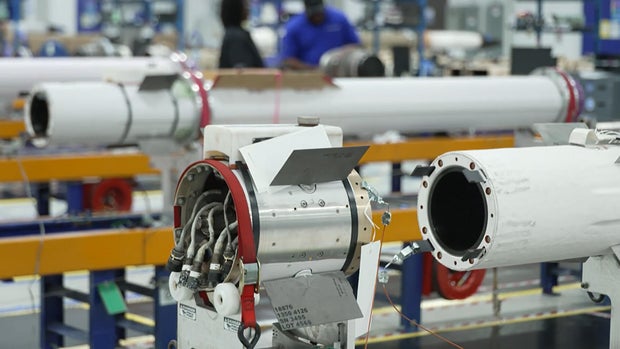
Each of these “bullets” costs about $4 million, and Lockheed Martin is currently turning out 750 of them a year – not nearly enough to replenish the estimated 1,500 fired in the war against Iran.
Mark Cancian, of the Center for Strategic and International Studies, has compiled estimates of the Patriot and six other critical weapons (including the Tomahawk; the Terminal High Altitude Area Defense missile, or THAAD; and the long-range Precision Strike Missile, or PrSM) used against Iran. He says the cost of munitions already fired off against Iran is in the vicinity of $25 billion.
Center for Strategic and International Studies 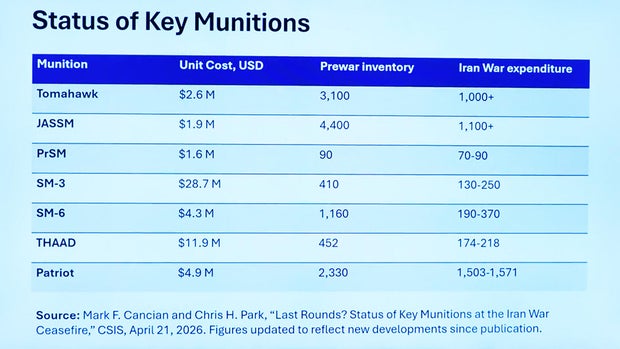
“If they fire a ballistic missile, we have to use one of our high-end systems to defend,” Cancian said.
Now in its seventh month, the unpopular war with Iran has exposed for all to see an unsettling fact: A chronic shortage of high-tech weapons, which was largely ignored by both Democratic and Republican administrations, until the U.S. increased military aid to Ukraine after the full-scale Russian invasion in 2022.
“The war in Ukraine was the wake-up call,” Cancian said, “because it became clear that we did not have adequate inventories or the surge capability to supply a protracted conflict.”
Then, this February, the U.S. attacked Iran. By April 8, according to Chairman of the Joint Chiefs of Staff Dan Caine, the United States Joint Force had struck more than 13,000 targets.
“It depleted the stockpiles quite considerably,” Cancian said.
Asked if the U.S. has enough weapons to see the war through, Cancian replied, “For a war against Iran, the answer is yes. The problem is a war against China. We might be able to provide enough munitions for a month, but getting on to month two or month three or four, that’s a great challenge.”
The Pentagon says, “Claims of U.S. munition shortages are false,” and only embolden enemies to attack American troops.
But Defense Secretary Pete Hegseth has been exhorting industry to increase weapons production to what he calls a “wartime footing,” which Lockheed Martin’s Tim Cahill describes as “controlled chaos.” “It’s just, move fast, figure it out, find what our obstacles are, break them down,” he said.
Lockheed Martin intends to increase Patriot production from 750 a year to 2,000, by laying on more shifts and increasing automation on the assembly line. “Hours are going to become minutes as we fully automate this factory to drive those rates up,” Cahill said.
It takes some six weeks to assemble a Patriot, but about two years to manufacture the 4,000 parts that go into it. Lockheed Martin depends on a vast supply chain – on the order of 500 to 1,000 suppliers – creating potential bottlenecks. “Our joke is, ‘How many parts does it take to build a missile?’ And the answer is, ‘All of them,'” Cahill said. “And so, all it takes is one single part somewhere along the line to keep from building up … we’ve had to rely upon single-source suppliers for many of our systems.”
The rocket motors which power the Patriot are made five miles away by the defense contractor L3Harris under time-consuming safety regulations. “We are working with a product that is certainly dangerous if not handled properly,” said Ken Bedingfield, the company’s president of missiles.
CBS News 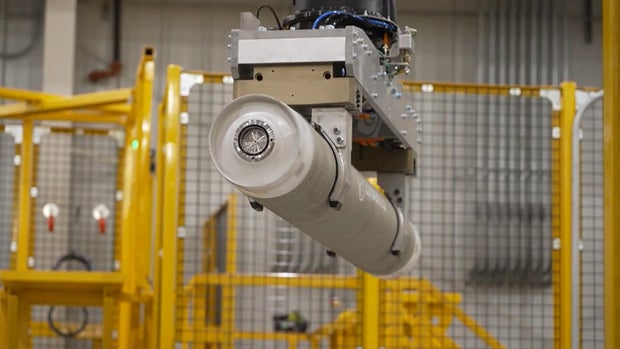
He says the rocket fuel in each of these motors has to be cured in an oven much like pottery in a kiln. “That cure time in the oven can take from days to weeks,” said Bedingfield.
The company has nearly doubled production of motors for the Patriot, and broken ground on a new, more automated plant, which is still 16 months away from completion. And as with Lockheed Martin, Bedingfield’s schedule is hostage to his ability to get enough of the parts he needs. “Sometimes there is only one qualified supplier, but we want that to be the absolute exception, not the rule,” he said. “Nozzles and cones are some parts that are schedule-challenged.”
Hegseth’s call for “speed, scale, volume, efficiency, maximum urgency” in rebuilding America’s arsenal is fueled by record trillion-dollar defense budgets, which polls show a majority of Americans do not support. Think of it as the rebirth of the Cold War military-industrial complex – only this time the complex includes disrupters like CoAspire, in Manassas, Virginia, run by Doug Denneny.
His company is producing a cruise missile meant to be launched from aircraft, at a fraction of what most cruise missiles cost. “A couple hundred thousand dollars,” he said.
CBS News 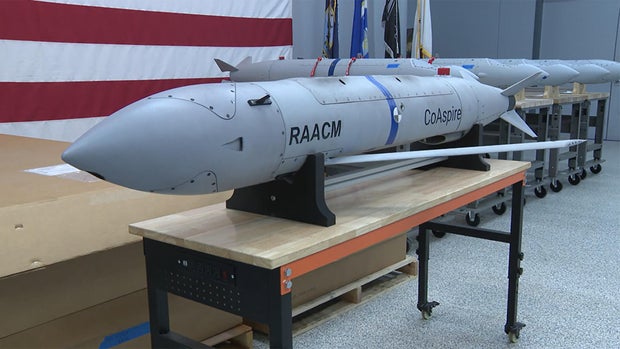
High-tech cruise missiles carry bigger warheads, and have a longer range than Denneny’s. “We’re trying to build these in high quantities, knowing that they’re not as exquisite,” he said, “but many of these will get through to the target.”
The Pentagon plans to buy 10,000 low-cost cruise missiles from CoAspire and other startups. Asked if his missile is a good enough weapon to go up against Chinese air defenses, Denneny replied, “It is. And if you have thousands of these, it’s very challenging for even a very sophisticated air defense system to take care of.”
CoAspire’s cruise missile has just 200 parts, some of them off-the-shelf commercial products, including BBs glued into the nose for ballast. “The engine comes originally from the hobbyist market,” Denneny said.
While Denneny is working on contracts worth $400 million to make affordable missiles, Lockheed Martin just signed a $59 billion contract to build high-performance Patriots.
Asked how long it might take the U.S. to replenish its stockpiles to pre-Iran war levels, the Center for Strategic and International Studies’ Mark Cancian replied, “It’s about one to five years, depending on the munition. Once we’ve rebuilt the inventories to the pre-war level, then we’ll take several years to get to a level that the war planners would be comfortable with for a war against China.”
For more info:
Story produced by Robert Marston. Editor: Jason Schmidt.
See more:


