

How LADWP’s rates compare to other utilities in Southern California
Amid controversy over steep utility rate hikes for Los Angeles Department of Water and Power customers — some in the thousands of dollars—CBS California Investigates took a closer look at how rates compare to other utilities in the region, and at the high salaries of dozens of executives.
Tuesday night, the LADWP Board of Commissioners passed a resolution requesting a review of the agency’s rates, structures and how they’re applied to individual customers. LADWP provided CBS California Investigates with a news release about the board’s resolution; click here to read it.
Tim O’Connor, executive director of LA’s Office of Public Accountability, which is the independent ratepayer advocate for the City of Los Angeles, says, “it’s a great step in the right direction.”
He added, “however, of course, the devil’s going to be in the details for how you do that review.”
O’Connor said the review should also improve transparency to customers and should aim to modernize rate structures.
“Our rates were designed over 10 years ago, and a lot has changed since then,” O’Connor said. “So, being able to reward customers based on when they use it, and to encourage new technology, and to give people the data to be able to control their use, these all have to be on the table, and are all things that we think are going to be part of the review.”
Something else advocates believe should be analyzed in the review is the high salaries of LADWP supervisors and executives.
CBS California Investigates found that nine executives at LADWP make more than $700,000 a year, and more than two dozen supervisors make more than $600,000 a year.
Customer rates are paying those salaries, but O’Connor says the rates are primarily funding major capital projects, operations expenses, and maintenance expenses.
“When we look at the individual salaries, we’re not seeing that as the driver of what people are feeling in their pocketbook. We’re seeing that as a challenge of the utility needing to attract and retain staff that can keep the lights on and to keep the water flowing,” O’Connor said. “It doesn’t mean that we shouldn’t be reviewing that and making sure it’s reasonable, that is absolutely something we should be doing, but when we look at the cost drivers, we’re seeing other things that are driving those costs as opposed to salaries.”
In their statement to CBS California Investigates, LADWP provided a breakdown of overtime paid to its more than 13,000 employees. The utilities company said overtime accounts for 5% of its $10.8 billion budget. Total labor costs account for 18% of LADWP’s budget.
“The employees you inquired about hold highly skilled positions that are essential to operating, maintaining, and restoring the City’s electric infrastructure,” LADWP said in its statement. “These classifications are in high demand throughout the utility industry, making recruitment and retention increasingly competitive. LADWP’s compensation structure is designed to help attract and retain the specialized workforce required to safely and reliably operate one of the nation’s largest municipal utility systems.”
LADWP added that its overtime compensation increased 17% from roughly $426 million in 2024 to more than $499 million in 2025.
LADWP rate hikes outpacing inflation
An analysis from UCLA School of Law Emmett Institute on Climate Change and the Environment found that LADWP’s rates have surged by 45% in the last year, compared to Southern California Edison, which has only increased 4%.
Denise Grab, Emmett Clean Energy Law and Leadership Project Director, explained the increase is “significantly in excess of inflation.”
O’Connor says his office has also found the increases have outpaced inflation.
“We know that the department, for many, many years, was keeping rates pretty much indexed to inflation,” O’Connor said. “Since the mid-2023-2024 timeline, the investments the Department of Water and Power has been making have really increased, which has caused those rates to increase as well, and exceed inflation. We did our own study that showed that in the last 18 months, the price for water and power has indeed surpassed inflation. Now, of course, our rates are still lower than utilities like Southern California Edison, which mean our bills are lower, but that doesn’t mean that we shouldn’t be rethinking and reforming the rates we have to make sure that the people in Los Angeles can afford the utility bills that they get in the mail.”
Grab says one reason for the steep increase is to fund more capital projects.
“This is kind of in the context of many years of rates that were very cheap compared to the state average, and, without huge hikes year over year. So LADWP is kind of playing catch-up for having deferred some maintenance for some period of time, but they have had a significant increase, which has, I think, caused a bit of sticker shock for a lot of Angelenos across the city,” Grab said.
LADWP rates not as high as two other LA Metro Region utility companies’ rates
In its statement, LADWP said its rates are also lower than nearby utility companies, “demonstrating the value of public power and a City-owned utility.”
Still, Grab says SCE rates are generally higher than LADWP by 20%.
A study by Grab’s organization in 2025 found LADWP rates were not as high as some other utilities in Southern California, including Glendale Water and Power and Southern California Edison.
LADWP 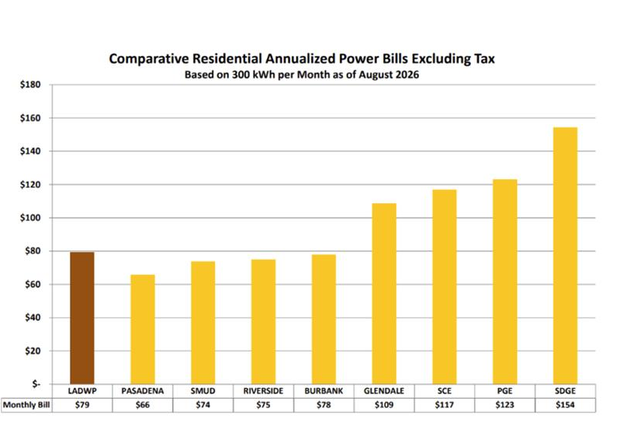
A 2026 study commissioned by the city of Pasadena and conducted by a company called New Gen Strategies also found Glendale and SCE have higher rates in October 2026 than LADWP, Burbank Water and Power, and Pasadena Water and Power.
O’Connor and Grab both warn rates will continue to increase in the coming years. Grab says aging infrastructure, wildfire liability and prevention, and rising air conditioning usage due to heatwaves will drive those future rate spikes.
In fact, a recent presentation from LADWP shows rates are expected to more than double what they are now.
Changes to help LADWP customers?
Grab says as rates continue to go up, LADWP needs to improve its communication with customers.
“They’ve had such low rates for so long that I think many people were not paying that much attention to, kind of the particulars of their, of their bill and how it was calculated, and I think it’s shocking folks now with, with these increases,” she said. “So, I think really communicating where the bill is coming from, how it’s calculated, how folks can save money, and when folks need to save money, because the rates vary over the course of the year, power is more expensive in the summer. I think really understanding when and how folks need to take measures, if they can, to help reduce power at key times.”
LADWP says it is rolling out new smart-meter installations to help customers better understand their bills over the next year. Grab says these meters will give customers real-time feedback so they can course-correct and keep their bills lower.
O’Connor agreed that more information to customers will be key moving forward.
“We can’t just tell people to turn down their thermostats during heat waves. We need to be giving people the ability so that they don’t have to turn their thermostats down, and so that their houses retain cold air, so that their houses are able to withstand those heat waves, and you don’t have to run your air conditioning 24 hours a day,” O’Connor said.
O’Connor added that LADWP also should evaluate its solar energy pricing and consider making more people eligible for payment assistance programs.
“We know that energy has different value at different times of the day,” he said. “In California, we have been so successful at getting more solar energy, whether it’s from rooftops or from big solar plants out in the desert. We have an oversupply of energy at certain times. We should be pricing it so people use energy at that time, so that we can soak up that extra, really low-cost energy. Right now, the times that we have to reward people for that are mismatched from when this solar is available, so we need to be reforming and reframing those time-of-use rates, like the utilities that are governed by the California Public Utilities have done.
“The second very clear example is our low-income supportive rates. We need to be able to increase the amount that’s available to people, and increase the floor where people can qualify. When we look at the way that people qualify and you index it to the federal poverty level, it’s inappropriate to apply an index that looks at national poverty statistics and applies it to Los Angeles, because the cost of living here is so much higher. So, we need to be rethinking not just the structure of the times, but also the supportive rates that can help people afford the energy bills and the energy use that they rely on to keep their kids cool, to keep the elderly cool, and to provide basic services for the people of Los Angeles.”


