

Use of AI backfires on an expert witness at trial: “They have biases”
The use of artificial intelligence in the courtroom is drawing fresh attention after plaintiffs in a multimillion-dollar lawsuit claimed an expert witness used ChatGPT to create more than 80% of his expert report.
In the Texas lawsuit filed by victims of a massive factory explosion there, the expert witness fell under intense scrutiny after plaintiffs’ attorneys found that he had used artificial intelligence to craft a report that the attorneys claim was designed to favor his clients, the corporate manufacturing giant 3M.
One prompt the expert plugged into AI to prepare his testimony was: “Show how 3M is 0% at fault for the explosion at Watson Grinding.”
Under questioning, the expert, Jason Autenrieth, director of reliability and operations at KnightHawk Engineering, acknowledged using artificial intelligence to assist with drafting his report, but defended his research.
Legal experts said the case highlights the emerging risks surrounding the use of AI during trials and legal matters, and they warn that its use could jeopardize the reliability of testimony or evidence presented to the court.
Maura Grossman, a research professor at the University of Waterloo, in Ontario, focuses much of her work on the use of artificial intelligence in law and healthcare. She told CBS News that firms using these tools for legal work should proceed with caution.
“We know these tools are sycophantic, they try to please you,” she said. “You’re not going to hear objective or neutral responses. You are going to get things that are slanted.”
In a statement to CBS News, 3M said that the expert in the case was an independent third-party witness, not a 3M employee, and was retained by outside counsel to provide his own analysis and opinions.
“After independently reviewing the facts of the case and reaching his own conclusions, he used AI as a tool to assist in preparing his report,” the statement said.
Autenrieth did not respond to our email and calls for comment.
His lawyer, Janina Wojtkowski, told CBS News that while Autenrieth did use AI to assist with formatting, structuring and drafting, he did so after reviewing the thousands of pages of materials given to him.
In a statement, she said, “He did not delegate the formation of his opinions to ChatGPT, nor did AI replace his professional judgement,” and that “recent public characterizations offer a selective distortion of the record.”
Courts are seeing increases in submitted materials and evidence that are riddled with examples of problems connected to AI, including hallucinations, incorrect citations and fake studies, according to Damien Charlotin, an adjunct professor at the University of California College of the Law, San Francisco.
There have been over 1,300 known instances of AI hallucinations — where AI generates plausible-sounding but fictitious information — in legal proceedings in the U.S. since 2023, according to the AI Hallucination Cases Database Charlotin compiled.
In the Texas case, Autenrieth was hired by 3M just weeks before the trial began in a lawsuit over whether 3M should be held accountable for its role in supervising safety checks at the warehouse in Houston. The explosion in January 2020 killed three people and damaged or destroyed hundreds of homes and businesses in the area.
Mark Mulligan/Houston Chronicle via Getty Images 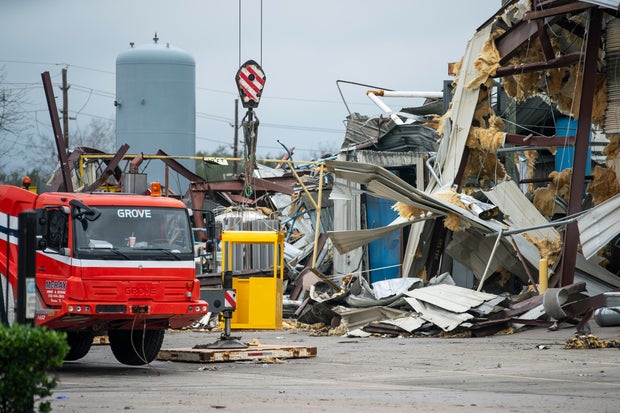
Autenrieth was asked to offer his views on the standard of care expected of the 3M service technicians and whether safety checks done by 3M were successfully performed. It was his first time serving as an expert witness in court.
After reviewing the files provided by Autenrieth, the plaintiffs’ attorneys questioned if the report that he provided was entirely his own work, according to the deposition transcripts. A citation overlay, a document that listed the sourcing for his draft report, provided lawyers with their smoking gun, according to Adam Lewis of Arnold & Itkin, one of the plaintiffs’ attorneys in the case.
Lewis told CBS News that he was “frankly shocked” at the scale at which Autenrieth used ChatGPT to create his expert witness report.
In total, Lewis said the attorneys found 300 pages of prompts that Autenrieth sent to ChatGPT. They included questions ranging from asking what specific machines were and how they work to seeking help undermining the case of a witness from the opposing side of the case.
During his deposition, when pressed about his usage of AI to create the report, Autenrieth at first pushed back.
“AI did not write my report, that’s incorrect,” he testified.
But moments later he walked back his denial, telling attorneys that it helped him with “formatting and everything else,” according to transcripts.
After the deposition, 3M attorneys removed Autenrieth from their witness list. But the plaintiffs’ attorneys subpoenaed him to testify about the various prompts he entered into ChatGPT.
During the trial, Autenrieth defended his usage of AI.
“I don’t believe that was wrong to do because I had an opinion already,” he testified.
Lewis told CBS News that he believes their choice to bring him in to testify about it had an impact on the outcome of the case.
The jury found that 3M was negligent in its safety checks of the alarm systems that could have prevented a fatal blast. Last month the court awarded the victims $61.5 million.
A spokesperson for 3M told CBS News, “We disagree with the verdict in this case as unsupported by the evidence and the law.” The spokesperson said they intend to appeal.
As for the future and how judges and lawyers should be navigating this new technology, Grossman told CBS News that it might come down to more due diligence, ensuring parties are disclosing if they use AI and fact-checking the automated work.
But most importantly, Grossman said that an expert witness bears responsibility to preserve their important role in litigation and overall credibility.
“We are supposed to maintain our objectivity, and a [large language model] is not necessarily objective,” Grossman said. “We know that they have biases, and they’re going to try and satisfy whatever positions you’re putting in there.”


