

Uncovering a Holocaust survival story
As a young girl taking out a box containing toy soldiers from her dad’s dresser drawer, Elizabeth Connolly was just curious, not trying to unearth a little-known piece of history. “I would go in and I would play with them, and I would set them all up on the floor,” she said.
But tucked in that drawer next to those toy soldiers was an envelope of photos, which Connolly found intriguing: “I always remember thinking, ‘Hmm, they don’t look like any of our relatives. I wonder who they are.'”
CBS News 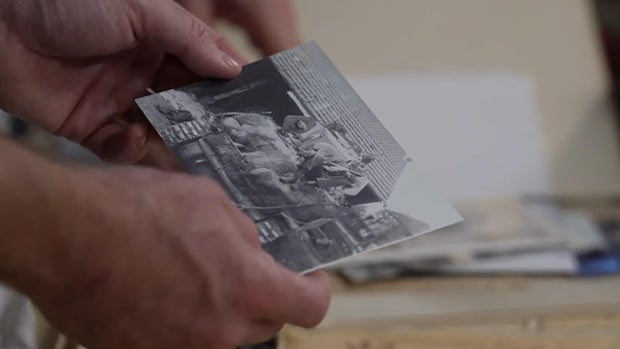
They appeared quite removed from her reality in Upstate New York. “There was one that just always drew me: It was a mom holding a little girl’s hand, coming up the hill, and there was another woman standing behind that was very, very thin,” she said.
The George Gross Collection/Matt Rozell 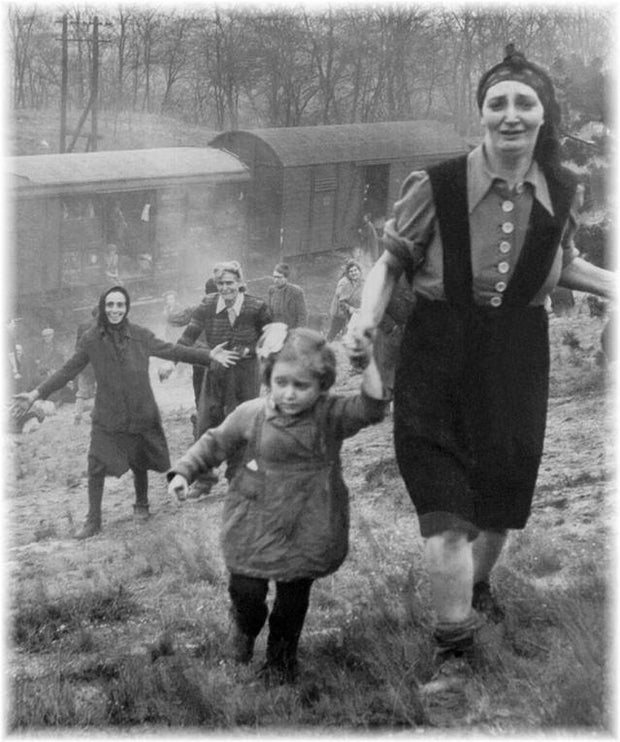
She’d asked her dad about them: “He would just say they were people that he came upon in a train, and that was it,” Connolly said.
Her dad, Carrol Walsh, a U.S. Army sergeant in World War II, kept the photos given to him by a friend, a fellow tank commander. “I think a lot of the soldiers during that time, they came home and they held a lot of those stories in,” Connolly said.
That’s partly why her son’s teacher, Matt Rozell, started a class project to collect the oral histories of veterans. While Rozell was interviewing Connelly’s dad in 2001, she interjected to ask him about the train.
“No, I didn’t tell him about the train,” Walsh answered.
Rozell recalls he was just about to shut down his camera when Walsh continued: “And he said, ‘A beautiful April day. We were zooming like crazy through the middle of Germany. We came across this train, and it was full of Holocaust victims.’ He said he looked inside the train cars. He saw the people in a very distressed state.”
Twenty-five-hundred Jewish prisoners from Bergen-Belsen were crammed inside, on their way to another concentration camp. On April 13, 1945, in the final weeks of the war, advancing American soldiers came upon the stopped train near Magdeburg, Germany, and provided care for the survivors.
Rozell did not realize at the time that he was uncovering a relatively unknown piece of history: “I was a young history teacher,” he said. “I was not schooled enough, believe it or not, in the Holocaust.”
Rozell posted that interview online, and eventually heard from dozens of survivors and liberators, inspiring him to write a book, “A Train Near Magdeburg.”
The former Hudson Falls, New York, teacher also organized reunions to bring together American soldiers with those they helped liberate, including Peter Lantos, who became a renowned neuroscientist and author.
In his London home, Lantos told us how he was just five years old when he was put on that train with his mom. “Her thinking was, anywhere can be better than Belsen,” Lantos said. “There were dead bodies lying around unburied, first by dozens, then by hundreds.”
His father died of starvation there. In all, he lost 21 family members in the Holocaust.
Lantos remembers the day they were liberated: “There was kind of a noise, and suddenly it became quiet. And then people started to shout, ‘Americans! Americans!'”
He does not really like talking about what happened, but, he said, “It’s a moral obligation to do it. Because we are the last survivors. I’m 86. In few years’ time, no one can tell you, ‘Yes, it is true because I was there.'”
James Bulgin, the head of public history at the Imperial War Museum, London, said, “The people on board that train are, in every meaningful respect, on the brink of death at the point in time that the Americans intercept them.”
Peter Lantos and Matt Rozell recently joined Bulgin in the Holocaust galleries he curated, which feature the story of the train.
Bulgin said, “You might say, ‘Oh, they’re being saved from Belsen. They’re being sent somewhere else.’ But the reality is of course, as soon as they get along the way and then the Nazis realize they’re not going to be able to get them to where they’re gonna get to, then the plan emerges to kill them.”
The episode reveals the chaos at the end of the war, Bulgin says, and the quirks of fate that lead to remembering this story of liberation and survival.
“Matt Rozell, when he was doing his interviews, didn’t know that he was going to stumble across the history of the train,” Bulgin said. “It tells us so much about the way history actually happens.”
That’s something award-winning filmmaker Mike Edwards knows well. While working on his upcoming documentary, “A Train Near Magdeberg,” his team unearthed a series of photos from that day which he brought to show Bulgin. In one picture, a man wears a photograph of himself showing what he looked like pre-Holocaust.
JFCS Holocaust Center 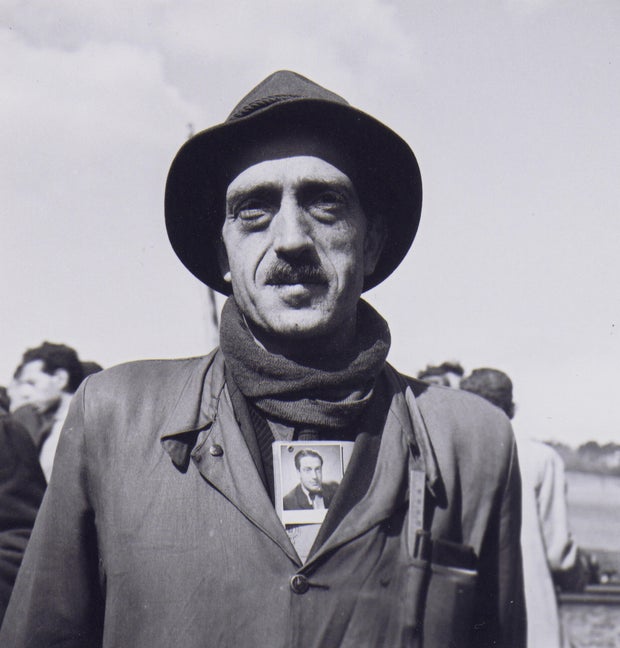
“I’ve literally never seen anything like that before,” Bulgin said. “It’s compelling, because you know about these things and you’ve seen some of it, but to see new things, every new kind of physical visual trace, gives a new insight.”
Mike Edwards has no direct connection to the train, but he has spent more than a decade on this passion project, which he’s screened for some students. Asked what about the story has struck him, Edwards replied, “I think it’s a story of humanity.”
One question posed to Edwards stays with him: “‘What do you hope people take away from this story?’ I said, ‘You know, each one of you, in your own lives, is going to have a “train near Magdeburg moment.” You’re going to have a choice of whether to care about somebody or not, to treat them as a human being or not. May you remember this story.'”
Now retired from teaching, Matt Rozell says the train story teaches a valuable lesson: “They didn’t have to stop. They didn’t have to help these people. But they did.”
He says there’s also a lesson here for all of us in the value of education: “Here’s a story that very few Americans know anything about, that they should. You know, we all say, ‘Never forget. Never forget.’ And it’s a great mantra. It’s very important. But what if we never learned it to begin with?”
To watch a trailer for “A Train Near Magdeberg” click on the video player below:
For more info:
- “A Train Near Magdeburg: A Teacher’s Journey Into the Holocaust, and the Reuniting of the Survivors and Liberators, 70 Years On” by Matthew A. Rozell (Woodchuck Hollow Studios Incorporated), in Hardcover, Trade Paperback, Large Print, Young Adult, eBook and Audio formats, available via Amazon, Barnes & Noble and Bookshop.org
- matthewrozellbooks.com
- TeachingHistoryMatters.com
- Documentary: “A Train Near Magdeburg” (coming soon)
- Imperial War Museum – London
- Historian James Bulgin, Head of Public History at IWM (Instagram)
Photos courtesy of:
- Tauber Holocaust Library and Archives of the JFCS Holocaust Center at Jewish Family and Children’s Services of San Francisco, the Peninsula, Marin, and Sonoma Counties
- The George Gross Collection/Matt Rozell
- Mike Edwards
Story produced by Michelle Kessel and Mikaela Bufano. Editor: George Pozderec.
See more:


