

True crime, where there’s nothing hotter than a cold case
Crime rates in America may be falling, but the appetite for true crime coverage? That’s never been bigger. And this fall, there’s plenty for fans of the topic to choose from, whether it’s streaming (like Netflix’s “Monster: The Lizzie Borden Story”), podcasts (“Crime Junkie”), popular broadcast series (CBS News’ own “48 Hours”), the big screen (“By Any Means”), and even good old-fashioned Court TV, it’s practically everywhere.
Random House 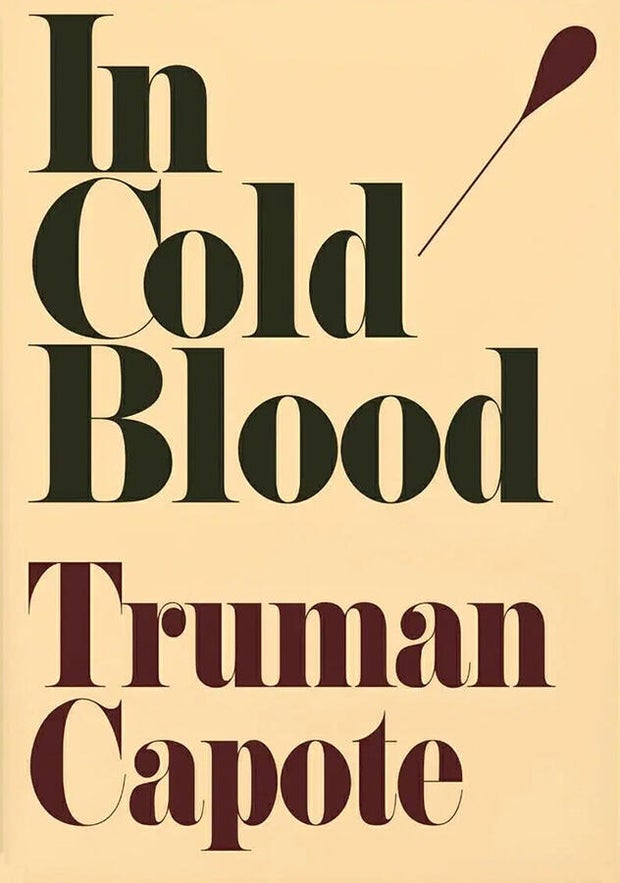
And the fixation isn’t new. Many trace the genre’s mass appeal back to the 1960s, when Truman Capote wrote “In Cold Blood” about the murder of the Clutter family in Kansas. “I read Truman Capote’s ‘In Cold Blood’ when I was probably 17, 18; it hit me as no other book has ever hit me,” said Jean Murley, a professor at the Savanah College of Art and Design, who studies the true crime phenomenon. “I just became more and more fascinated with it – the sort of drama, the fact that these stories were real, horrifying.”
One such real and horrifying story was the hatchet-deaths Lizzie Borden was accused of back in 1892, which took place in the very Massachusetts house where we sat for our interview.
“It was a very high-profile crime at its time, with a woman at the center of, you know, two acts of horrific violence,” said Murley. “And it has continued to be super-interesting, because she was never convicted. Nobody was ever convicted for those crimes.”
Yes, the murders of Andrew Borden and his wife, Abby (Lizzie’s stepmother), are technically still unsolved. “It’s an open case, yes,” said Murley. “A very, very cold case.”
Fall River Historical Society 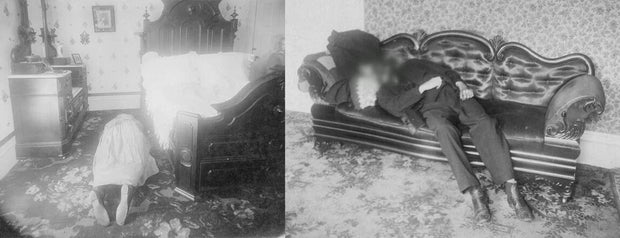
Murley says it’s no wonder why we as humans are naturally drawn to these tales of murder, mayhem and mystery. “For women in particular, of course, there are all of the reasons for anybody to be interested in true crime,” she said. “True crime deals with the biggest emotions within the human experience … The stakes are incredibly high. We’re talking about facing mortality. We’re talking about violence.”
All of which are topics that Karen Kilgariff and Georgia Hardstark tackle each week as hosts of the wildly popular “My Favorite Murder” podcast. “We were recording in my little one-bedroom apartment in Hollywood with no air conditioning and a lot of cats,” said Hardstark. “I really just wanted a hobby. And we loved talking about those things, so, let’s give it a shot! Let’s just talk into microphones instead of at each other.”
“I think we thought no one was listening,” said Kilgariff, “and that we were just kind of talking to each other and, you know, a group of people that were kind of like-minded, but that it wasn’t really anybody.”
But people were listening – a LOT of them. More than two billion downloads over the show’s lifetime, with sold-out live shows and even their own podcast network, Exactly Right Media.
CBS News 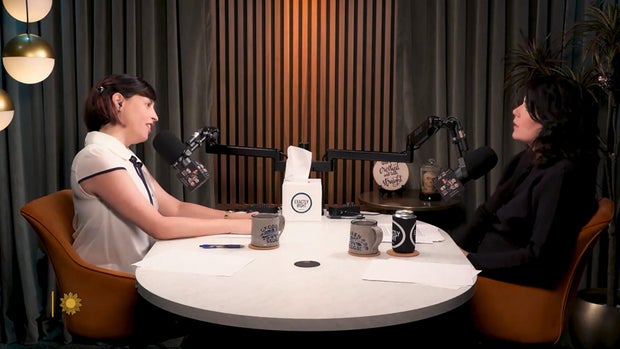
But is it really okay to build an entire entertainment empire on people dying? And who are all of those listeners, who call themselves “murderinos”? According to Kilgariff, “It’s people who care and try to show up with a kind of presence and an awareness. Our audiences are, when we do live shows, clapping ’cause everyone’s so excited to, like, be together. But then you can turn a corner, and everything gets really quiet.”
Hardstark said, “True crime as entertainment, at first, worries a lot of people. We want it to be about the victims, because we understand as women how vulnerable we are. We’re not entertained by true crime. What we want is all the information about human experience that we can get.”
A place you can get a lot of that information is CrimeCon, held this year in a place that knows all about the topic: Sin City – Las Vegas. CrimeCon is a yearly get-together for fans of the genre, and the folks who make the content that those fans can’t get enough of. Folks like “48 Hours” correspondent and “Sunday Morning” contributor Erin Moriarty, who could barely walk through the convention without being mobbed.
CBS News 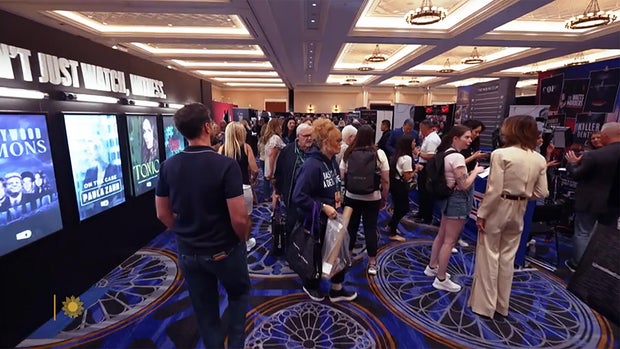
Moriarty said, when she first heard about CrimeCon, “I was worried about coming here. This isn’t a joke. These are real people whose lives have been drastically affected by these cases. There are victims. There are people who have been wrongfully convicted. And they all have something to say. And I did not want to be part of anything that would make fun of that or trivialize it.”
Thanks to the internet, a lot of these CrimeCon attendees also spend their free time trying to actually solve the crimes using publicly-available information.
“We know that, in some cases, if there are the sleuths online, they are so adept at tracking people down, that they might be able to get clues,” Moriarty said. “What I get concerned [about] was, in the Idaho case, the Bryan Kohberger case, there were people who went beyond sleuthing, and they pointed their finger at innocent people.”
Steve and Kristi Goncalves are maybe the most unlikely CrimeCon attendees you could think of; their daughter, Kaylee, was one of four University of Idaho students murdered in 2022. “It doesn’t feel like it’s been three-and-a-half years,” Kristi said. “It’s weird because sometimes it feels like it’s been ten years. But then other times it feels like it was just yesterday.”
They were here to promote a new foundation they’ve started, in Kaylee’s honor, called Murder Has a Name, to privately fund investigations of unsolved murders. “She would be proud of us,” Kristi said. “And this foundation, I can’t wait for this to be just a huge success.”
Steve added, “Hug another family and say, ‘There’s your guy.’ Hopefully I can call and be like, ‘Guess what, we got the hit.'”
CBS News 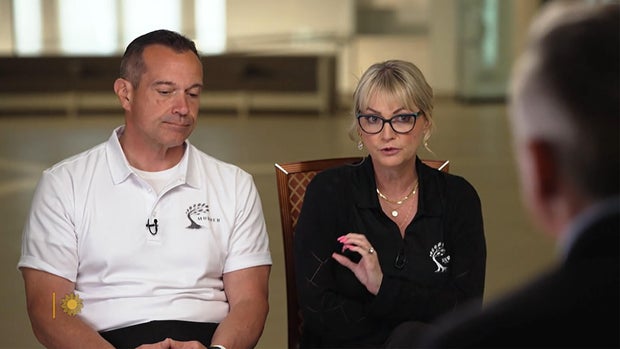
Kristi and her family, including Kaylee, did watch true crime shows: “We all watched it. We’d watch ’48 Hours,’ ’20/20,’ ‘Forensic Files,’ ‘Disappeared,’ we watched ’em all, you know? And we would talk about ’em like, ‘Oh my God, did you see this one? Oh my gosh, you gotta watch this one. This one is, like, so good. You know, it’s crazy, this and that.’ And I don’t watch anymore. I mean, now it’s like, my daughter is a ’20/20,’ she is a ’48 Hours,’ you know? She is on ‘Dateline.'”
“Now you know what those people are feeling,” said Steve.
“You know. When you see them crying on TV, you know exactly what they’re feeling and what they’re going through,” Kristi said.
And, Steve added, “It doesn’t get better.”
Back at the Lizzie Borden House – which, interestingly, is now a popular bed and breakfast, complete with fake murder victims and a gift shop – Jean Murley says she’s solved at least one mystery when it comes to true crime: how to engage with the genre without it making you a monster.
“I think that most people are good,” she said. “I think that most people would never harm somebody else. Violence is unimaginable to the large majority of people. I really do believe that. If when you are watching something, listening to something, reading something, if you can just keep reminding yourself that this is a real person.”
Story produced by Gabriel Falcon. Editor: Jason Schmidt.
See more:


