

People are scrambling to find wads of cash dropped all over American cities
The video shows what appears to be a roll of cash so thick it would impress Tony Soprano. White-gloved hands place the wad in an empty Doritios bag, and toss it casually under a tree. The camera pans to show people hanging out in the park, completely unaware of the treasure left in their midst.
Shortly after, an Instagram account called @nyc_money_hunt posts the video, writing beneath it, “Finders keepers Tag us when you find the cash!”
The next day, more than 200 miles north, an unrelated account called @passpassbos makes a similar post: “Here’s a BIG drop for you Boston. Like this reel if you think the patriots are taking down the bills today!!!! 🏈 good luck on this hunt”
Subsequent videos from each account show winners finding the money within minutes, and others not far behind, arriving too late to claim the loot.
Cash drop accounts like this have proliferated on social media sites, sending people running in cities across the country, chasing money left in candy bags, envelopes, key locks, takeout boxes, paint cans or covering things like basketballs and footballs (that the winners also get to keep). They’re tossed beneath bushes, in pipes, taped to walls, left on the side of busy thoroughfares, near leafy park trails, in trash bins and stuffed into tree hollows. The money hunters arrive in sweats, suits, underdressed for cold weather like they ran out of their apartment, or overdressed for a sprint in the heat like they darted from the office, on bikes and scooters, in cars and by foot. Don’t worry about that cop inspecting the garden bed, he’s actually hoping to win the cash.
Sometimes the drops are tied to promotions — for personal injury attorneys, local restaurants, a youth soccer club. Other times the only thing being hyped is the account itself.
Most accounts are tied to large national networks. Some are anonymous, also known as faceless. CBS News reviewed more than 50 accounts spanning about two dozen cities, with over 7 million followers between them.
“This is tied to a larger cultural moment,” said Jessica Rauchberg, who studies creators and lectures at the University of Leeds School of Media and Communication. “It says a lot about where we are right now, where there’s growing inflation, a lot of economic uncertainty.”
Instagram / @PassPassNY, @PassPassLA 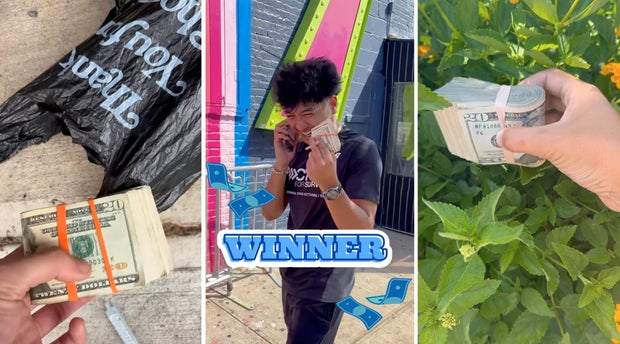
Recently, NYC Money Hunt neatly tucked a massive stack of cash into a Ziploc bag and left it in a puddle beneath a Staten Island shopping center pylon. The anonymous person later posted a follow-up video showing the money was quickly found. It also showed a herd of cars and people descending on the lot, gingerly navigating the puddle while searching for the cash.
NYC Money Hunt did not answer questions, but said in response to emails from CBS News, “We’re incredibly passionate about both the brand and the business.”
But what exactly is the business?
Kristopher Groves, president of PassPass, which does cash drops across the country, said the model can lead to a variety of revenue streams. Even for anonymous accounts, local business sponsorships are typically at the core of the business, they can get marketing and first-party data like names and emails of people who expressed interest in sponsored giveaways.
Cash drop accounts with large followings can also generate revenue from Facebook, YouTube and other platforms through the millions of views garnered by their videos.
“There are a lot of ways this content can make money through other channels if they’re really savvy,” Groves said.
In the case of PassPass, that’s meant building an app around the cash drop experience. Users with a basic account can play free arcade games with the chance to win prizes, including cash, and paid subscribers get access to bonus entries for giveaways, travel deals and hints about the locations of upcoming cash drops.
Groves said the app has about 200,000 registered users, and the company’s collection of city-specific cash drop social media accounts (for instance @PassPassChicago), bring in 100 to 150 million views a month.
Groves and his brother Edgel, who’s CEO of the company, have contemplated whether this is “just a fad, because the economy sucks right now.” They think not.
“When in the history of humanity have people been tired of free money?” Groves asked rhetorically, before recalling an instance when he said a guy sped to a cash drop in a Lamborghini.
“He’s like, ‘This is so much fun. When’s the next drop?’ He’s in the car with his girlfriend and he peels away in his Lambo,” Groves said, laughing.
He said the company hit on the model about two years ago, after pursuing a discounts business they thought of as “like a Groupon-disruptor.”
“We were struggling with how do we get people to download the app if we don’t have a Groupon-style budget to acquire users?” Groves said. An “aha” moment came when they tried marketing through cash drops.
Their videos did so well, they decided to build technology around it, “making it a whole community where people who love this on Instagram can actually turn this into a much bigger business and product.”
“People will literally just sprint out of their office, because they realize it’s across the street. And if they get it, they’re like, ‘Oh, I won!’ And they throw up their hands like, ‘I gotta get back to work,'” Groves said.
Instagram / @PassPassSanDiego, @PassPassPittsburgh 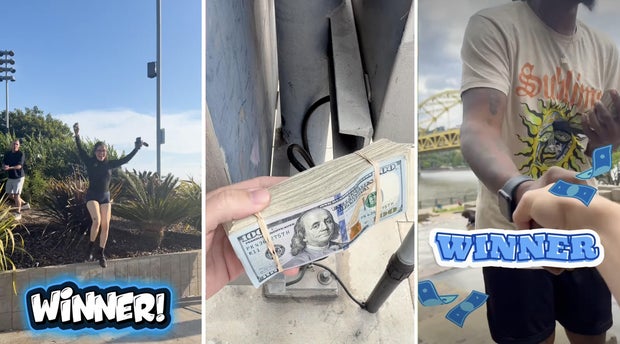
That happened in December when CBS Pittsburgh tagged along with a PassPass drop in that city. Less than a minute after the drop was posted, a woman came running into the cold.
Out of breath, clutching a box of cash that she stuffed beneath her sweatshirt, the winner, who said her name was Nicole, told the station, “It is a merry Christmas. It’s going to help a lot.”
While PassPass is part of a company with founders who are open about their identities, some accounts maintain complete anonymity. Rauchberg said faceless accounts often succeed because “there’s a mystery, there’s an intrigue,” but also because they lack the overt salesmanship of influencers hawking brand partnerships.
“It’s connected to this larger reckoning of what we’re calling ‘the influencer recession’ or ‘the influencer death,’ ‘influencer cliff,’ whatever you want to call it. Audiences are beginning to realize that influencing and content creation, while it seems to build on reality, is not always real,” Rauchberg said.
NYC Money Hunt is committed to the bit. His videos show only his white-gloved hands and no identifying features or information. He’s racked up more than 400,000 followers on Instagram and thousands more on other platforms. Two people who sponsored drops with the account, on behalf of a local youth soccer club and a Cinnabon franchise, said they were unable to discuss the arrangements.
The anonymity can sometimes be divisive. Some on Instagram and TikTok have made videos or posts speculating without evidence that the drops are fake, or the wins staged. Others lavish the account with praise.
“Is so nice you do this, God Bless you. People need this help 😍😍😍👏👏👏” one follower wrote after a drop last winter. CBS News was unable to track down any of the winners from his more than 100 drops, but a witness to one described a woman in tears when she realized she had found the money.
On Jan. 24, the man behind the account dropped a huge clump of cash into a Juici Patties takeout container, leaving it in a corner of the chain’s downtown Brooklyn franchise, as part of a sponsored promotion.
Store employee Latoya Samuel watched the whole thing from behind the counter. She described seeing unsuspecting people walk right by the prize before a woman came in purposefully and found it.
Samuel said the moment hit the woman hard.
“Oh, she was crying,” Samuel said. “She was saying, ‘I can buy this for my child, I can buy that for my child.”
Overhearing the conversation, a new employee was surprised and excited to hear one of the drops happened at her store. She said she follows the account.
“It’s just fun. Gives you some hope,” she said. “A lot of people really need it.”


