

Key moments from trial of Matthew Farwell, ex-cop charged with killing Sandra Birchmore
The fate of Matthew Farwell is now in the hands of a jury in his trial over the death of Sandra Birchmore, who federal prosecutors say was killed by the former Massachusetts police officer after years of sexual abuse that started when she was a teenager.
Farwell has pleaded not guilty to killing the 23-year-old and her unborn son in 2021. Prosecutors accused Farwell of staging Birchmore’s death to look like a suicide.
Prosecutors said Farwell started sexually abusing Birchmore when she was 15 and he was 27. The two met through a police youth program that’s designed to teach children about law enforcement careers. Farwell, who worked for the police department in Stoughton, Massachusetts, was an instructor for the program.
Stoughton Police Department via AP 
Birchmore’s manner of death was initially determined by local authorities to be a suicide, but was later changed to undetermined. After a federal investigation into her death, Farwell was charged in 2024 with killing a witness or a victim, with prosecutors alleging that Farwell killed Birchmore to silence her about the abuse. In 2025, he was charged with causing the death of an unborn child.
Farwell didn’t take the witness stand during the trial. Attorneys gave their closing arguments on Friday before the case went to the jury.
During the trial in U.S. District Court in Boston, Farwell’s attorneys didn’t deny that he had an affair with Birchmore. His lawyers instead tried to cast doubt on prosecutors’ theory of the case and how she died.
Here are some key takeaways from the trial:
Birchmore wanted a baby from Farwell
When Birchmore learned Farwell was expecting a third child with his wife, Birchmore said she wanted him to impregnate her or else she would tell his wife about the affair, according to text messages revealed during the trial.
“I gave him an ultimatum and I’m getting his baby. He was not at all happy about it,” Birchmore said in a text message to a friend in October 2020.
By late December, she was pregnant. On Dec. 28, 2020, she sent Farwell a picture of a poster that said, “Congrats we are goin’ to be parents!”
When Birchmore told Farwell he needed to be with her while she’s in labor, he responded, “You are truly the worst person on the face of the earth.”
The next day, Farwell texted Birchmore, “You extorted me to get what you wanted.”
Prosecutors said they met up, and things didn’t appear to go well.
“I’m not going to be around anymore and neither is your kid. Congrats. Hope you’re happy,” Birchmore texted Farwell.
She also told Farwell she felt scared when he was next to her during that meetup. “I thought you were going to hit me,” she said.
Jessica Rinaldi/The Boston Globe via AP 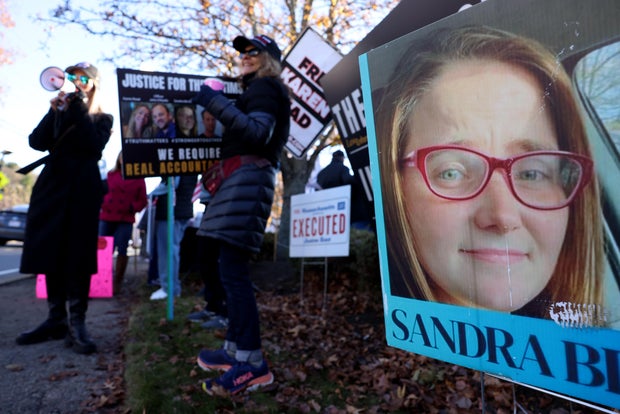
Prosecution and defense experts disagree on Birchmore’s death
Birchmore’s body was discovered Feb. 4, 2021, when police conducted a welfare check at her apartment after she didn’t show up to work . She was found hanging in a seated position from a door handle by a duffle bag strap.
Prosecutors argued that Farwell used the strap to strangle her and then staged the scene to look like a suicide. Farwell’s attorneys, however, noted that Birchmore had written an apparent suicide note in a journal in 2017 and searched on the internet, “What color is the suicide ribbon,” days before she was found dead.
A strangulation expert for the prosecution, Dr. William Smock, told jurors that Birchmore’s death was a homicide. He said a clasp on the strap caused an injury on her chest and was hanging from the knob, suggesting that the scene was staged. He also said the fracture of Birchmore’s hyoid bone, located in the neck, rarely happens in suicides.
Defense expert Heather Garvin, an anthropologist who has a doctorate in anatomy, said the fracture doesn’t definitively prove that Birchmore’s death was a homicide. Another defense witness, forensic scientist Alicia McCarthy, testified that she couldn’t conclude with certainty that the injury on Birchmore’s chest was caused by the clasp.
Dr. Thomas Andrew, a former chief medical examiner for the state of New Hampshire who testified for the defense, said that all of the factors of Birchmore’s death made him think it was a suicide. “This is not manual strangulation,” he said.
Farwell wasn’t the father of Birchmore’s child
DNA testing found that Farwell didn’t father Birchmore’s child, FBI Special Agent Heidi Kelsch testified. Instead, the father was Jason Pickard, a defense contractor for the Air Force who met Birchmore when he was a recruiter for the Army Reserve.
Birchmore, who was 22 at the time, was considering enlisting when she and Pickard, who was married at the time, started texting in December 2019. The relationship eventually became sexual.
When Pickard found out about Birchmore’s relationship with Farwell, he said he urged her to report him, but she didn’t. He also didn’t alert authorities about the relationship.
“I was afraid. I was a married man. I was a recruiter and she was a recruit. I knew what it would do to my marriage, I knew what it would do to my children, I knew what it would do to my career,” he said. “I also respected her request not to tell.”
When Birchmore became pregnant, she told Pickard the child wasn’t his.
Witness says Farwell got upset by call about relationship
On Jan. 20, 2021, about two weeks before Birchmore was found dead, Stoughton police dispatcher James Fitton received a call from a female who “alluded to a relationship between Matthew Farwell and her friend,” Fitton said during his testimony.
When Fitton told Farwell about the call, he got angry. “He got visibly and audibly upset with me,” Fitton said.
He threw out the note he took about the call after he said his supervisor told him to forget about it.
When Farwell texted Birchmore about the call, she told him the friend owed her money.
Farwell went to Birchmore’s apartment before she died
Matthew Dunne, a Massachusetts State Police trooper who initially investigated Birchmore’s death, testified that after he learned of the relationship between Birchmore and Farwell, he interviewed Farwell on Feb. 6, 2021.
According to Dunne, Farwell went to Birchmore’s apartment on Feb. 1, 2021, which was the last day she was at work.
“The account he provided was that he went over there to break up with her,” Dunne said.
Farwell also told Dunne he went to see Birchmore to tell her that the baby wasn’t his.
Farwell left Birchmore’s apartment building after her phone stopped moving
Dunne confirmed that before Farwell left her apartment, data from Birchmore’s phone showed it had stopped moving.
An FBI digital forensic examiner, Christopher Beckstrom, told jurors Birchmore’s phone locked for the last time at 9:13 p.m. on Feb. 1, 2021.
Farwell was seen on surveillance video footage entering Birchmore’s apartment building that night wearing a hooded sweatshirt and face mask at 9:14 p.m. Birchmore texted Farwell to let him know her door was open, Beckstrom said.
Birchmore’s phone recorded eight steps were taken at 9:40 p.m., and no other steps were recorded after that time.
At 9:43 p.m., Farwell was seen on the security camera leaving Birchmore’s building. Kelsch testified that Birchmore usually sent Farwell a text after he visited her, but she didn’t that night.
Birchmore was excited to be pregnant
Birchmore worked for the school district in the nearby town of Sharon, Massachusetts. She was excited when she learned she was pregnant, according to testimony from Cheryl Carlson, an assistant principal who worked with Birchmore.
Birchmore told Carlson she wanted the baby “to have someone to love.”
Birchmore also opened up to Carlson about the baby’s father.
“She said that the father was in a committed relationship and that there were children involved, and that the plan was that he was going to leave his situation when her child was born,” Carlson said.
She also testified that Birchmore had told third graders that the father was her police officer boyfriend.
Carlson was caught off guard when she learned Birchmore’s death was initially called a suicide.
“Suicide didn’t make sense to me,” she said. “Because she was so excited to have that baby, she was so determined to have the baby, it didn’t fit with her character.”
Farwell told state police his relationship with Birchmore started much later
Farwell provided Dunne with a different account of his relationship with Birchmore than what prosecutors said. According to Dunne, Farwell said the relationship had been going on for about two to three years, which would have made Birchmore 20 or 21 at the time they began seeing each other.
“I believe he said he was intoxicated at some point and they encountered each other,” Dunne said.
But that account conflicts with text messages between Birchmore and Farwell that were read during the trial about how their sexual relationship started when she was 15. When prosecutors asked Dunne if Farwell’s contradictory statements were factors in the investigation, Dunne said they were given weight.
“All of this has to be taken into context with the full investigation, but they were definitely given weight,” Dunne said.
State police didn’t take notes during initial Farwell interviews
Dunne’s first interview with Farwell in the school parking lot wasn’t recorded and he didn’t take any notes. During the trial, he testified that was a tactical decision so Farwell would talk to investigators.
When Dunne and his supervisor, Sgt. John Fanning, who knew Farwell, interviewed him a few days later, neither of them took notes, Dunne testified.


