

Huge, invasive Joro spiders are spreading in several states again. Here’s what to do if you spot one.
The large, scary-looking Joro spider that can make massive webs is popping up again in multiple states, but researchers say the invasive species is essentially harmless to humans.
The spider species native to East Asia was first spotted in the U.S. in Georgia in 2014. Since then, sightings have been reported in more than a dozen states, primarily in the Southeast.
The adult female Joro spiders are yellow with bluish-green stripes and black and yellow legs. Their bodies can be up to 1 inch long and they have a leg span up to 4 inches. Males are smaller and mostly brown in color.
While they have been referred to as flying spiders, you won’t see one of the large adults soaring through the air. Researchers say only the young spiders are capable of something called ballooning, where they release silk that catches in the wind, carrying them long distances — a technique that’s not unique to this species.
So far this year, Joro spiders have been spotted in Georgia, the Carolinas, Tennessee and Alabama, according to public trackers.
The Great Smoky Mountains National Park, which sits on Tennessee’s border with North Carolina, told visitors Tuesday that the spiders “may be hanging in a web near you.”
“The invasive joro spider has been slowly spreading through the Smokies, and we need your help to track its whereabouts,” a post on the park’s Facebook page says.
Stuart Cahill/Boston Herald via Getty Images 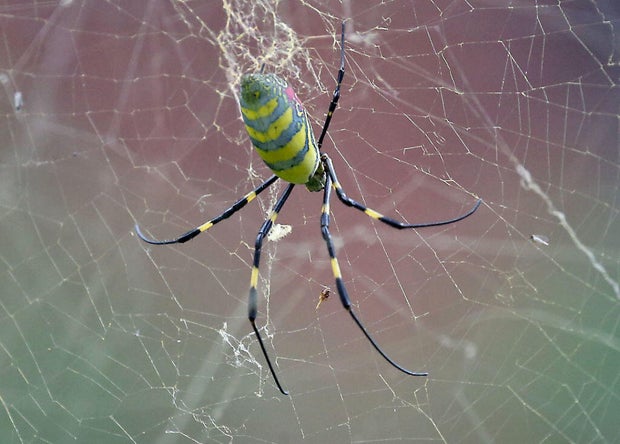
Reports of sightings will help researchers at the University of Tennessee who are mapping the spread of the species, the post says.
What to do if you see a Joro spider
If you see one of the spiders in Great Smoky Mountains National Park, take a picture and report it through the iNaturalist app or email UTKJoroProject@utk.edu, the park says.
Despite it being an invasive species, the park says not to disturb the spiders.
Caitlin Jones, who identified herself as one of the researchers in the comments of the park’s post, explained why the spiders should be left alone.
Primarily: It’s illegal to disturb wildlife in national parks.
But another reason is spiders that are native to the region, including other orb-weavers, can easily be mistaken for Joro spiders.
“We also don’t know what they are actually doing to our native orb-weavers,” Jones wrote in a comment. “That’s my area of research and my reason for leaving them when I see them.”
Outside of national parks, it may not be illegal to kill the spiders, but it’s not necessarily encouraged either. Sightings can also be reported to iNaturalist or other data collectors.
Massive webs but minimal harm
The spiders are a natural pest control and currently don’t appear to harm crops or trees like some other invasive species.
Joro spiders are also unlikely to bite humans, according to a study published last year in the Journal of Medical Entomology.
Researchers examined spider-human interactions in what they believe to be the first controlled study of spider bites.
“During these interactions, spiders primarily moved to avoid human contact, and bites were incredibly rare, mainly occurring when spiders were forcibly restrained,” the researchers said.
Stuart Cahill/Boston Herald via Getty Images 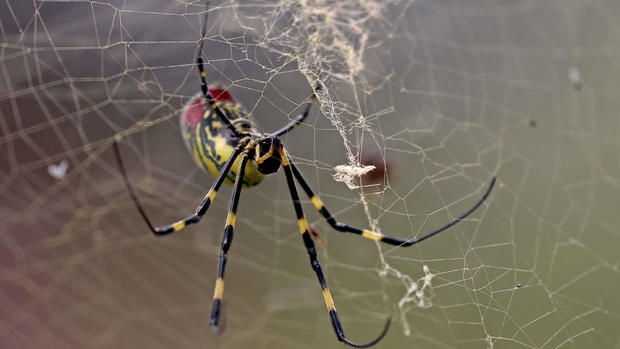
When bites were forced to occur, “recipients of bites reported low levels of pain, and other symptoms associated with the bite were highly localized and transient,” the authors of the study wrote.
The spiders are unlikely to go inside homes, researchers said, but they might make large webs on the outside of houses or other structures. If they are a nuisance around your home, experts have recommended using a broom or stick to move them and their web far away from where they were.


