

Does Mangione’s guilty plea in federal case jeopardize his state murder trial?
Luigi Mangione’s guilty plea on Friday in the federal case tied to the shooting death of a healthcare executive nearly two years ago is now generating questions about what will happen with his state murder trial, scheduled to get underway in just three weeks.
Mangione admitted Friday to killing UnitedHealthcare CEO Brian Thompson in December 2024. He pleaded guilty to federal charges of interstate stalking resulting in death and stalking through use of interstate facilities resulting in death. Both carry a maximum potential sentence of life in prison, which Mangione acknowledged in court he understood.
The judge scheduled sentencing for Dec. 18.
Meanwhile, Mangione is also facing state charges of second-degree murder and weapons and forgery charges. A first-degree murder charge was tossed out in September 2025.
His lawyers, led by high-profile attorney Karen Friedman Agnifilo, have repeatedly argued the state trial amounted to double jeopardy. It’s a claim they will likely pursue even more aggressively now that he’s pleaded to the federal charges.
“Despite this being a single, isolated event, Mr. Mangione has been unfairly treated since the outset in every way and has successfully fought off terrorism charges and the death penalty, while also fighting at the same time two simultaneous prosecutions in two jurisdictions who are trying to punish him twice for the exact conduct,” Agnifilo told reporters outside court after the plea hearing.
Agnifilo said they have filed in state court to dismiss those charges based on the double jeopardy claim.
Here are some of the biggest questions remaining in the wake of Mangione’s plea deal.
What is double jeopardy and how would it apply to Luigi Mangione?
Double jeopardy is a clause in the Fifth Amendment that says individuals cannot be prosecuted twice for the same crime.
All of Mangione’s crimes in New York — he is also facing weapons charges in Pennsylvania, where he was arrested — stem from the shooting of Thompson, a father of two who was gunned down on a Manhattan sidewalk as he headed to a company investors conference. The specific state charges, however, are different.
Barry Williams/Pool via REUTERS 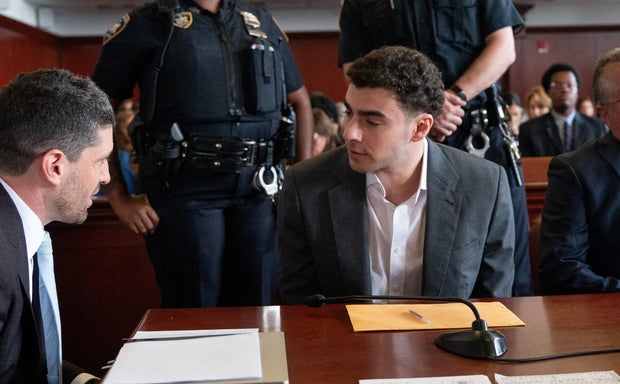
“New York law does not permit a person to be prosecuted and punished twice for the exact same crime under a statute that covers successive prosecutions, it’s also known as the double jeopardy law,” Agnifilo said.
But a spokesperson for Manhattan District Attorney Alvin Bragg, who is prosecuting the state case, said his office plans to continue its work and fight any challenges in court.
“Since December 2024, the Manhattan D.A.’s Office has been tirelessly preparing to pursue a trial conviction in New York State Supreme Court for the alleged cold-blooded murder of Brian Thompson,” the spokesperson said in a statement. “We are encouraged that Mr. Thompson’s family received a measure of accountability today. While federal sentencing is pending, we are prepared to litigate the defense motions. The Manhattan D.A.’s Office remains committed to seeking justice for Mr. Thompson and his family.”
Regardless of what is eventually decided in the courts, it seems likely the state trial will be delayed.
“It is significant to note that since the beginning, there has been this jockeying between the state and federal prosecutors, first, about who would go first at trial,” said CBS News legal reporter Katrina Kaufman. “Federal prosecutors tried to go first, but the state judge said emphatically that he felt New York did all the work here.”
Is double jeopardy different in New York?
The fact that the case took place in New York does change the equation. New York has a state law that is more generous to defendants than the Fifth Amendment double jeopardy clause, according to Jessica Levinson, a CBS News contributor and professor at Loyola Law School in Los Angeles.
The New York state law says you can’t have successive prosecutions for the same course of conduct and the same acts, Levinson said.
“The defense is going to argue that the federal stalking charges and the state murder charges are based on the same set of conduct and the same set of facts,” Levinson said. “The prosecution is going to say, ‘But wait, there’s a carve-out in state law.’ And those exceptions deal with situations where the elements of the crimes, the elements of federal stalking versus the elements of the state murder charge, are substantially different.”
Agnifilo confirmed Mangione’s legal team would pursue the double jeopardy argument in talking to reporters after Friday’s hearing.
“He’s been treated differently from every other defendant charged with this offense in New York,” she said. “However, thankfully, New York law does not allow this.”
Timothy A. Clary/AFP via Getty Images 
Does double jeopardy apply to Luigi Mangione’s case?
It will be up to New York State Supreme Court Justice Gregory Carro, who is presiding over the state case, to decide whether New York’s double jeopardy clause applies to Mangione’s state trial.
Mangione’s defense team said it has already moved to make that argument in a court filing.
“Today’s guilty plea triggers the [double jeopardy] statute, and we just filed our motion in state court explaining why the state charges must be dismissed under New York’s double jeopardy protections,” Agnifilo said Friday.
In addition, it will have to be decided if Mangione’s admission to killing Thompson in open court Friday could be introduced in the state trial, Levinson said.
“I think what the defense believed they could get in exchange for this guilty plea is potentially two things,” Levinson said. “One of them being accepting responsibility and hoping that serves as a mitigating factor when the judge does give a sentence. The other … is the hope that in deciding to say, ‘I’m pleading guilty,’ that includes a prosecution in the legal sense.”
“What he’s hoping is that under New York law, which prohibits successive prosecutions, that means that a judge will dismiss the murder charge against him,” Levinson continued. “I think that’s a difficult argument for him to make.”
Joe Tamburino, an attorney and legal analyst, told CBS News he agreed Mangione’s federal plea should not exclude a state trial.
“New York’s law is trying to prevent intentional murders, whereas the federal government is trying to prevent stalking or crossing state lines to stalk a victim, and the victim dies. So we have two different types of charges with different elements,” Tamburino said. “And those charges are designed to prevent different types of harm. So I don’t think double jeopardy would prevent New York state from continuing with their prosecution.”
Thompson’s family, in a statement after the guilty plea, seemed to indicate they wish to see a state trial.
“We remain mindful that additional proceedings in New York and Pennsylvania are still to come, and we will continue to seek the justice Brian deserves,” they said.


