

Christa Pike surviving her execution was “unparalleled.” But it wasn’t the first botched lethal injection.
Christa Pike, the only woman on Tennessee’s death row, received two doses of a lethal drug in a Nashville execution chamber Wednesday night. But she didn’t die.
Although her survival was “unparalleled,” as one expert said, it was the latest example of a botched execution attempt involving lethal injections in Tennessee and elsewhere around the United States.
“All of this was predicted, and the court did nothing,” said Steve Ferrell, an attorney for Pike, at a news conference Thursday, referencing the state’s history of problems with its lethal drug protocol.
Pike, 50, was condemned for the 1995 murder of her former classmate Colleen Slemmer, then 19, whom she and two others tortured and killed in a manner widely described as gruesome, horrific and disturbing. Eighteen at the time of the attack and 20 at her sentencing, Pike was the youngest woman sent to death row in the country’s modern capital punishment era.
The extent of Pike’s injuries after the failed execution was unclear, but her attorneys said Thursday that she was still alive and receiving “lifesaving medical care” at a hospital. A doctor told CBS partner BBC News that Pike would have likely suffered traumatic brain injury.
Her legal team had said in an emergency motion to halt the execution Wednesday night that she had not lost consciousness, retained a heartbeat and could be heard audibly snoring on the gurney, despite correctional staff administering two syringes’ worth of the drug pentobarbital to her through an IV. At one point, Associated Press reporter Kim Chandler, who witnessed the execution, said Pike “looked toward prison officials and asked if it was supposed to feel that way.”
“The case of Christa Pike lays bare multiple reasons why the death penalty should be abolished,” United Nations human rights chief Volker Turk said in a statement on Thursday. “The prolonged suffering — physical and mental — arising from multiple failed execution attempts is abhorrent, and cruel. And there are key fair trial questions still unresolved.”
AP Photo/George Walker IV 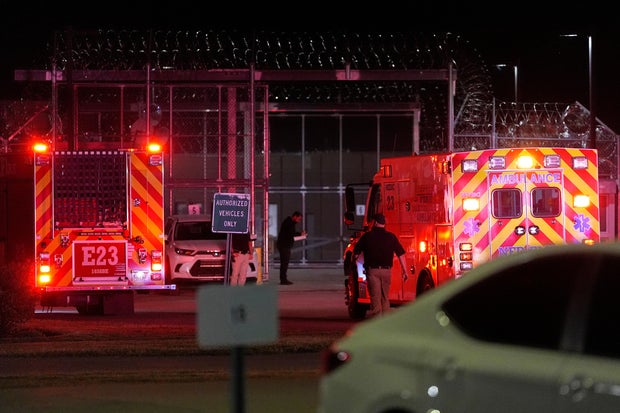
Tennessee Gov. Bill Lee, whose denial of Pike’s clemency petition this week allowed the execution to move forward, has since announced the state will cancel the one remaining execution scheduled to take place this year, so that “a comprehensive, third-party review to determine exactly what occurred” on Wednesday night could be conducted.
A problematic history
Pike’s bungled injection wasn’t a first for Tennessee. Earlier this year, in May, the state halted the planned execution of death row inmate Tony Carruthers when officers failed to establish an IV line through which to administer his lethal injection, after trying to do so for more than an hour.
At the time, Carruthers’ attorney said he had been “tortured,” telling CBS News that he groaned and bled from multiple attempted injection sites as staff tasked with handling the execution repeatedly punctured him in his chest, arms, feet and neck.
The defense team representing Carruthers had asked a Tennessee district court to stop the execution, alleging the ordeal “constituted cruel and unusual punishment,” in violation of his constitutional rights, but the request was denied on the grounds that a burden of proof to demonstrate the state’s actions were “cruel and unusual” hadn’t been met.
Lee ultimately granted Carruthers a yearlong reprieve from execution, meaning that he’ll return to the chamber a second time to be put to death after that. The governor said he wouldn’t reconsider Carruthers’ clemency petition, even as gaps in forensic evidence sparked public doubt over the legitimacy of the murder conviction for which he was sentenced to death.
Carruthers was among seven U.S. inmates whose executions by lethal injection failed because of issues establishing an IV line in the modern death penalty era, although researchers say other instances may exist. His attorneys’ allegations of torture and unconstitutionally cruel punishment also echoed similar accusations from representatives of other inmates who’ve experienced botched execution attempts due to this problem.
In addition to Tennessee, these incidents have happened in Alabama, Arizona, Florida, Oklahoma and Texas, according to the Death Penalty Information Center, an organization that provides data on capital punishment but doesn’t take a position on it.
Pike’s survival was “singular and unparalleled,” marking the first execution where an inmate remained alive after receiving lethal drugs, versus other instances where failure to locate a vein ultimately prevented the drugs from being administered, Robin Maher, the Death Penalty Information Center’s executive director, told the AP. In a statement, her organization drew connections between Pike’s execution and that of Clayton Lockett in Oklahoma in 2014, where Lockett appeared to survive the procedure but died of a heart attack while still in the execution chamber.
AP Photo/George Walker IV 
Tennessee resumed executions in 2025 after a three-year hiatus, triggered by controversy and criticism surrounding its execution protocol. Lee, in 2022, said the pause would allow for an investigation into its lethal injection process after it was determined that corrections officials didn’t test the lethal drugs they’d planned to use for that year’s execution of Oscar Smith for bacteria. That review led Tennessee to alter its lethal injection protocol, shifting from a procedure involving three different drugs to the current one used in Pike’s case, consisting solely of pentobarbital.
The Tennessee Department of Correction said it “followed every step of the State’s lawful, established execution protocol” in a statement released after Pike’s procedure.
“The lethal injection chemical in the protocol has consistently been effective, and the protocol does not allow for additional procedures beyond what was carried out this evening,” the statement said.
“Veiled in secrecy”
Experts and groups advocating against the death penalty have sounded alarms for years about issues with lethal drugs used in executions. Declining support for capital punishment nationwide and skepticism over how executions were being carried out led pharmaceutical companies over the last decade or so to cut ties with state corrections departments, which, in turn, struggled to acquire lethal drugs.
Advocates have said this shift has contributed to increased incidents of lethal injections gone awry, accusing states of putting inmates to death with expired or untested chemicals. Because the details of execution protocols, within and outside of Tennessee, are frequently allowed to be kept secret, contesting them, legally, is difficult.
Pike’s lawyers had raised concerns about Tennessee’s protocol in appeals leading up to the execution, and Pike herself said she was “nervous” about how the procedure would play out in a letter that CBS News obtained from her spiritual adviser this week.
“I am not afraid to die. I’m only nervous about the process,” said Pike in the letter, written Monday, before she learned Lee had denied her petition for clemency.
Her attorneys said the circumstances around Pike’s execution proved their concerns had been valid.
“Tonight the State of Tennessee once again failed to carry out a lawful execution,” they said in a statement. “We take no pleasure in being right, but the concerns raised by Ms. Pike proved to be true: difficult vein access, blown veins, degraded pentobarbital, no emergency medical care available when things inevitably go wrong, all under a protocol that remains veiled in secrecy.”


