

A woman’s postpartum symptoms wouldn’t go away. A brain tumor was to blame.
Lisa Fasone and her partner had always dreamed of having two children. When Fasone became pregnant in 2021, everything seemed to be falling into place. They welcomed their daughter in February 2022.
As they adjusted to life as a family of three, Fasone struggled with lasting postpartum symptoms, including night sweats and headaches. At first, she chalked it up to breastfeeding and hormonal changes. She also wasn’t getting her period, and attempts to become pregnant again were failing. By her daughter’s second birthday, she became concerned.
“I’m like, ‘OK, it’s been a year since I stopped nursing, and I still feel absolutely awful,'” said Fasone, now 32. “Something was wrong, and I kind of kept brushing it off. But after a year, I put my foot down.”
Fasone went to her OB-GYN. Tests showed elevated prolactin levels, a hormone made by the pituitary gland. Prolactin influences fertility and helps produce breast milk. Prolactin levels typically change during pregnancy — but Fasone’s levels had yet to go back to normal.
Her care team found a tiny benign tumor, known as a prolactinoma, on her pituitary gland. It was producing excess hormones and causing her symptoms. Operating on such tumors is rare, said Dr. Stephen McGill, a neurosurgeon at Northwestern University who treated Fasone. Instead, it is usually treated with an oral medication that typically results in the tumor “melting away on its own,” McGill said.
Lisa Fasone 
Fasone started taking the medication and quickly began experiencing side effects, including severe dizziness. Worst of all, she said, was being unable to try for a second baby. The medication she was on wasn’t safe in pregnancy, and her increased prolactin level would have made conceiving extremely difficult anyway. Fasone said she would watch her toddler daughter play by herself and fear the worst.
“Most people probably know somebody that has had an infertility journey or has gone through that process, but you never really think it would be you, especially when you had such an easy time getting pregnant with your first one,” Fasone said. “I had to really come to terms with the idea that maybe I will just always have one child, and that’s just the way it’s going to be.”
“I didn’t really have a choice”
After one year on the medication, a follow-up scan showed something alarming: The prolactinoma was growing, not shrinking. Now, it was the size of a pea, atop a gland only the size of a blueberry. The growth of the tumor, plus Fasone’s side effects and fertility concerns, made surgery an option, McGill said.
Kateryna Kon/Science Photo Library/Getty Images 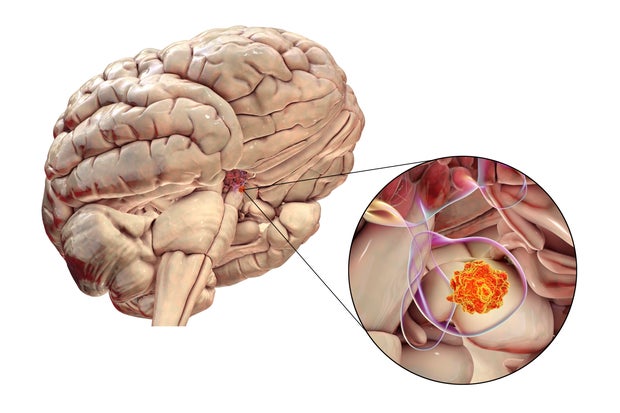
The procedure could result in complications to the pituitary gland, including further fertility issues, McGill said.
But for Fasone, it was worth the risk. The surgery could offer a complete cure and a life off the medication. It was the first time she felt a “glimpse of hope” since her diagnosis.
“I think at this point I didn’t really have a choice. I wasn’t able to live the life that I had imagined,” Fasone said. “So I kind of took it head-on and said, ‘If I want to have a normal life and finish my family, this is just something that I have to do.'”
A “really exciting” surprise
Fasone underwent the minimally invasive procedure, done through the nose, in April 2025. The next day, she received positive news: Her prolactin levels were “completely down to normal” after the tumor’s removal. Then, 30 days later, she had her first period since becoming pregnant with her daughter nearly four years ago. It seemed like all was returning to normal.
But then a screening several weeks later showed her prolactin levels rising again. Fasone was devastated.
“One risk of the surgery was (McGill) may not be able to get all the tumor out, and there may be some tumor cells left that would restart this problem again. That’s what I thought was going on,” Fasone said.
But then tests found a happier cause: She was pregnant with her long-awaited second child.
“I was shocked. I was kind of traumatized by the whole process, and experience that I had gone through,” Fasone said. “It was really exciting and rewarding.”
Lisa Fasone 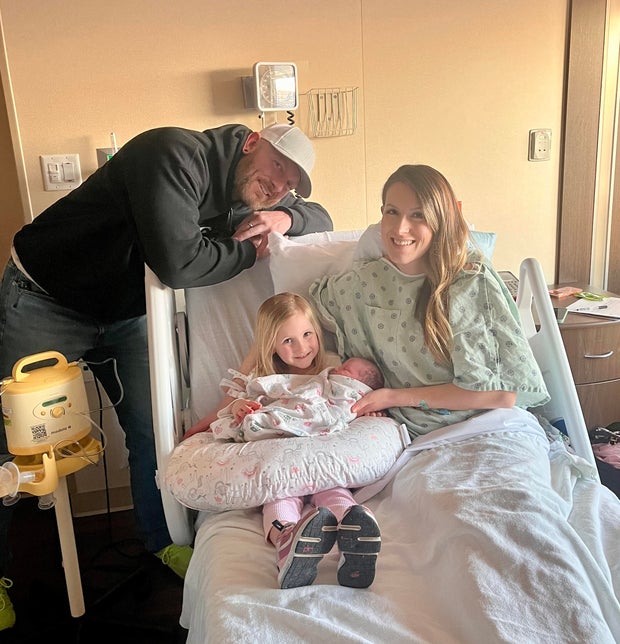
“Just super grateful”
Fasone welcomed her second child, another daughter, in February 2026. Her pregnancy was typical, McGill said, and her prolactin levels have returned to normal. Fasone was able to breastfeed, as she did with her first child, who loves being a big sister. Now, she’s back at work and recently earned a doctorate of medical science. It’s a lot of change, but it’s exciting, she said.
“We’re just super grateful to be where we’re at,” Fasone said.
McGill and Fasone’s endocrinologist will regularly measure her prolactin levels to ensure that she remains in good health and that her hormones are not disrupted. She will also receive an annual MRI for the next five years, McGill said. The scans will slowly be spaced out, McGill said.
José M. Osorio 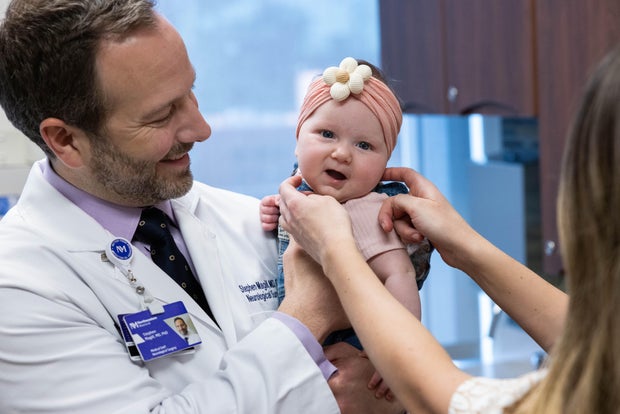
Fasone said she’s looking forward to spending less time at the doctor’s office. But for now, she’s just focusing on finally having the family she always wanted.
“When I had my baby in February, I was thinking back to a year ago, when I was scheduling brain surgery,” Fasone said. “When I was returning to work from maternity leave in May, I was thinking back to a year ago, returning to work after having brain surgery. I was really in an awful position and I didn’t know what the future was going to be like. To look back and remember where I was a year ago is really incredible.”


