

Alligator Alcatraz held detainees in “cramped conditions,” sometimes “small metal enclosures,” DHS watchdog finds
The Department of Homeland Security’s internal watchdog is sharply criticizing conditions at the Florida immigration detention center dubbed “Alligator Alcatraz,” finding that detainees at the now-closed facility were held in “cramped conditions” — in dozens of cases, people were held for up to two hours in 18-square-foot enclosures.
The DHS Office of Inspector General issued its 33-page report Monday after conducting an unannounced inspection of the state-run facility earlier this year. Alligator Alcatraz — which was shuttered in June — had initially been cast by Trump administration officials as a model for how DHS could ramp up detention space as it aims to boost deportations. But it drew intense criticism from advocacy groups who alleged poor conditions, which DHS has strongly denied.
Most of the detainees at Alligator Alcatraz were held in soft-sided tents on an airstrip in the middle of the Everglades, which were further divided into dormitory-style units surrounded by metal fencing and filled with bunk beds. The enclosures didn’t have common areas.
The OIG report found these housing units “did not provide detainees with sufficient living space.” When at capacity, they provided 28 square feet per detainee — less than half of the 75 square feet required under Florida state jail standards, according to OIG.
The report said this arrangement “may harm detainees’ physical and mental health.”
It also found that detainees were given one hour of recreation time three days per week, and were able to shower on Mondays, Wednesdays and Fridays. The report noted that ICE’s standards call for detainees to have at least six hours of recreation time per week, or at least one hour a day for five days a week, and Florida’s standards require daily access to showers.
OIG staff also reported seeing cage-like “small metal enclosures,” which were 52 inches long and 52 inches wide. Some 79 detainees were held in these enclosures, which staff called “calming areas,” between July 2025 and January 2026.
The watchdog described these enclosures as “highly unconventional” and said they do not “align with standards for humane treatment.” It recommended removing them. (All of the inspector general’s recommendations were closed out because the facility ceased operations.)
DHS OIG 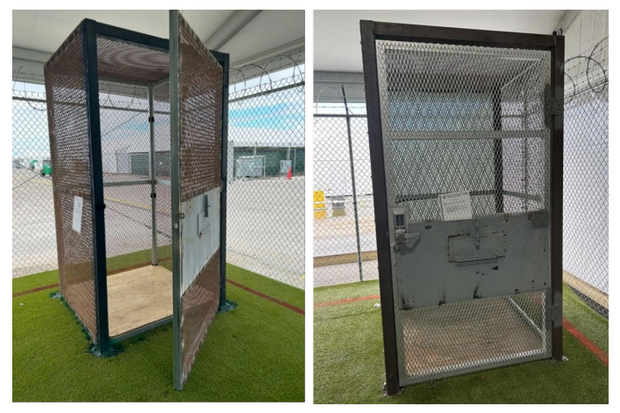
Staff told inspectors that detainees “asked to spend time in the small metal enclosures” in order to have time alone, and the doors were left unlocked. An ICE notice on the outside of the enclosure said detainees “may leave at any time.” But OIG said in at least one case, the enclosure “may have been used as a disciplinary tool,” with a detainee placed inside for 26 minutes for failing to comply with commands.
Detainees were kept in the enclosures for no more than two hours. On average, they stayed inside for just under an hour, OIG said.
“Use of these small metal enclosures for any reason is unprecedented among ICE facilities inspected by OIG,” the report read. “Confining individuals in small metal enclosures for any reason presents significant risks to detainee health and well-being.”
OIG said staff at the facility “could not clearly identify which detention standards they used for holding detainees on immigration-related charges,” which the report warned “increases the risk that detainees may not receive appropriate care.” In assessing Alligator Alcatraz, OIG said it looked at both Florida state jail standards and ICE’s national standards, and applied whichever was more restrictive.
The OIG report adds to more than a year of criticism of Alligator Alcatraz from Democratic lawmakers, immigration attorneys and advocacy groups. There was also opposition to the site from environmental organizations concerned about the impact on the ecosystem and a Native American tribe that argued the facility endangered protected lands.
The facility’s detainees were legally in the custody of Immigration and Customs Enforcement, and were accused of being in the U.S. illegally or otherwise violating federal immigration laws.
State and federal officials have long defended the site, which President Trump personally toured in the summer of 2025 along with Florida Gov. Ron DeSantis.
“Alligator Alcatraz was consistent with the same federal detention standards employed by previous administrations, including Biden and Obama,” a DHS spokesperson told CBS News in a statement Monday. “All detainee facilities are clean, and any allegations of inhumane conditions or excessive use of force are FALSE.”
CBS News has reached out to the Florida Division of Emergency Management, which operated the facility, for comment.


