

Strange symptom and a “weird” referral led to a woman’s Stage 4 cancer diagnosis: “Saved my life”
Kate Ping wasn’t concerned about the bloating in her abdomen at first. She was too busy running two family businesses and worrying about her son, who was about to undergo open-heart surgery.
Ping, 69, always had digestive and gut issues when she was stressed, so she chalked it up to that.
When her symptoms still hadn’t receded two months after her son’s successful operation, she made an appointment with her doctor. Her abdomen was so bloated it felt tender around her belly button, she said.
Ping expected to be scheduled for a colonoscopy. But the nurse practitioner she saw surprised her and ordered a CT scan.
“In my head, I’m thinking, ‘That’s weird. Why did she do that?'” Ping recalled.
The CT scan returned devastating results: Ping had Stage 4 ovarian cancer. The disease had spread throughout her body. Patients with Stage 4 ovarian cancer have about a 30% chance of surviving an additional five years, according to the American Cancer Society.
“I was completely shocked,” Ping said. “I couldn’t even pronounce any of this stuff, and I was really, really panicky. … My husband and I were like deer in headlights.”
Kate Ping 
A “very insidious” disease with subtle symptoms
Once Ping processed her shocking diagnosis, she began researching care options. A family member helped her get an appointment with Dr. Premal Thaker, an oncologist at the Washington University School of Medicine who treated Ping.
Ovarian cancer is often diagnosed in the advanced stages, Thaker said. There is no test for the disease, and its symptoms are often subtle. It is the fifth-leading cause of cancer death for women in the United States, according to Johns Hopkins.
Thaker called the disease “very insidious,” noting many of its symptoms are similar to signs of menopause or more mild conditions.
Signs to be aware of include abdominal bloating like Ping experienced, a rapid feeling of fullness while eating and changes in bowel habits or urination. Ovarian cancer can cause the abdomen to fill with fluid, leading to that bloated feeling and weight gain even as a person’s diet dwindles, Thaker said.
Because Ping’s cancer was so advanced, Thaker determined the best course of action would be chemotherapy to shrink her tumors, followed by surgery.
“I truly think you saved my life”
Ping struggled with the treatment regimen. She lost her hair and dealt with side effects including nausea and fatigue. Each cycle knocked her out of commission for about a week, she said. But her numbers kept improving. The constant encouragement from Thaker kept her going, she said.
“I had chemo every three weeks, and every time I went, I was greeted by [Thaker] with positive news,” Ping said. “It was really profound to go, every single time, and get good reports and good progress.”
Kate Ping 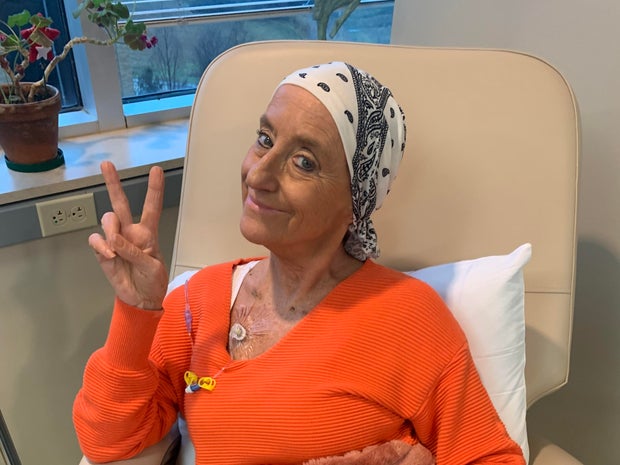
Ping was also buoyed by a full-circle moment that came a few months into her treatment. Her primary care doctor’s office, where her husband also receives care, called to confirm an appointment he had scheduled. Ping picked up — and recognized the voice on the other end of the line.
“I said, ‘Are you the person that ordered my CT scan?’ And she said, ‘Yes, I was,'” Ping said. “She told me that one of her best friends died from ovarian cancer, because it went undetected. She read my symptoms and thought, ‘This is worth doing.’ … I said, ‘I truly think you saved my life.'”
“A lot of change”
After several sessions of chemotherapy, Ping underwent surgery in February 2025. The operation included a hysterectomy and a thorough search of her internal organs to make sure there was no cancer present there. Thaker said the operation went smoothly.
Ping spent six weeks recovering from surgery, then resumed her chemotherapy regimen to destroy any remaining cancer. That was followed by several immunotherapy infusions to reduce the risk of a cancer recurrence.
Ping had her last infusion this spring. Being told she would no longer need to come into Thaker’s office regularly was “unreal,” she said. Ping continues to take a chemotherapy pill daily, also aimed at reducing the risk of recurrence. About 70% of ovarian cancer patients will see their disease return, according to the Ovarian Cancer Research Alliance. Ping said she tries not to think about those risks.
Kate Ping 
“There’s a lot of change, and it just becomes part of your life,” she said.
Instead, she focuses her energy on raising awareness for ovarian cancer and its symptoms, inspired by the nurse practitioner who ordered the scan that discovered her own disease.
Those efforts have led to an outpouring of support from her local community, she said. She and her son are both back at work at their two restaurants. It’s not unusual for patrons to share their stories of cancer treatment and recovery with her, she said. Ping tries to encourage everyone who opens up.
“They come into the store, and they’ll share their experiences … and my main thing is there really is hope,” Ping said. “Before I went through this, I would have just been like, ‘Oh my God, that’s terrifying.’ But now I know that there is hope.”


