

How Trump drafted upcoming renovations for Washington Dulles, a “terrible airport”
As he fiddled with ideas earlier this year for how to rejuvenate Washington Dulles International Airport, the capital’s aging federally owned airport, President Trump asked a handful of the design and engineering firms competing for the contract to create three-dimensional models so that he could better picture the designs, multiple sources told CBS News.
The hefty tabletop models were taken back and forth to the White House multiple times for the president’s perusal and his edits to plans for the terminal transport buses, parking lot location, baggage handling system, underground trains and general airport aesthetic, sources told CBS News.
This week, Mr. Trump intends to publicly reveal his plans, two of the sources said. He was scheduled to make a formal announcement Wednesday from the Oval Office with Transportation Secretary Sean Duffy, but the timeline could shift.
Mr. Trump has called Dulles a “terrible airport” that “was incorrectly designed.” Privately, the president has vented about “parking that’s two miles away” and has called the current mobile lounge transportation system “crazy,” sources told CBS News.
It’s the latest makeover the president has dabbled in during his second term, after the White House East Wing and new ballroom, Kennedy Center, and various parks in Washington.
His preferred that the new Dulles design preserve the iconic sloped-roof main terminal, designed by Eero Saarinen, but would refurbish the interior with an open foyer and new ticket kiosks for the airlines, one of the sources said.
Andrew Harnik / Getty Images 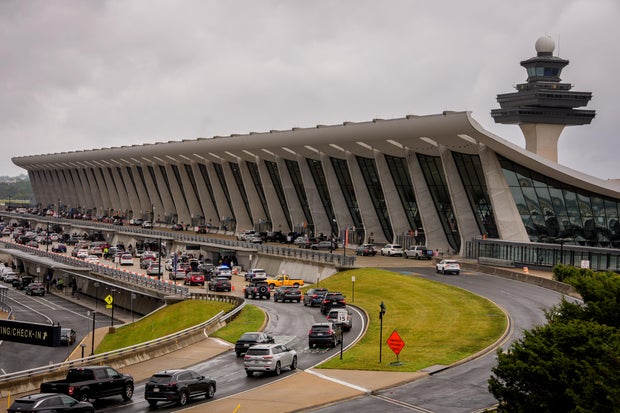
The $22.5 billion renovation will scrap the mobile lounges, colloquially called “people movers” and arguably the most unpopular component of the international airport. They have been used at Dulles since 1962.
A new underground U-shaped aerotrain will bring travelers to their terminals, along with moving sidewalks. The existing aerotrain only serves the A, B and C concourses, and not the D concourse where the United Airlines gates are located. More moving sidewalks are also going to be added.
The Washington Post / By Bill O’Leary TWP via Getty Images 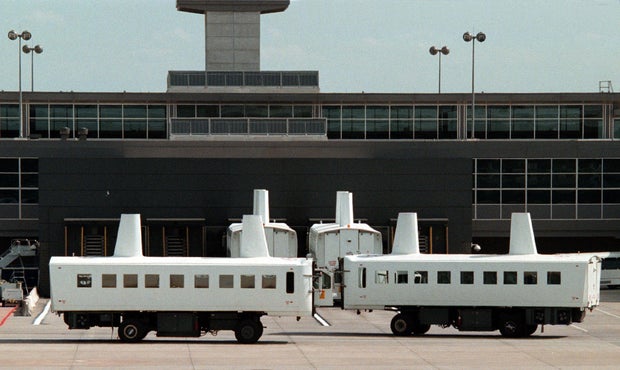
The plans include a major terminal expansion: Four new linear concourses where the current A, B, C and D gates are. The C and D gates, constructed in 1985, were meant to be temporary terminals for United Airlines but have remained in place for over 40 years.
The new design will move the parking lot closer to the main terminal for travel convenience.
In recent months, Mr. Trump hosted charrettes, calling in executives from development and finance companies to the Oval Office to make pitches, and he hounded his advisers by phone with suggestions, according to sources familiar with the conversations.
Roughly 30 proposals were submitted for the project, including HNTB, STV Group, Jacobs, Ferrovial, and AECOM, one of the firms that is working on the president’s White House ballroom project.
Ferrovial, which most recently developed the new Terminal 1 at John F. Kennedy Airport in New York, proposed a new main terminal that featured a wavy roof design. Mr. Trump rejected that.
Jacobs’ proposal included a bridge that passengers would cross to go between terminals and that would be built high enough that planes could pass underneath, but the president disliked the design of the bridge.
An HNTB design was the most dramatic – essentially a new airport built from scratch with an additional main terminal at the other end of the property. Mr. Trump thought it would be cumbersome to rebuild while keeping plane traffic moving.
BlackRock’s proposal was all-encompassing, offering to finance the renovations and complete the build, according to sources familiar with the bid. The asset management giant proposed operating the airport, too, wresting control away from the Metropolitan Washington Airports Authority, and taking its revenues. That plan was found to have multiple complications. United Airlines, the primary airline serving Dulles and carrying roughly two-thirds of daily passengers, opposed the BlackRock takeover.
The president ultimately chose a design that builds on the existing infrastructure and works with United. Scott Kirby, the airline’s CEO, met with Mr. Trump about the project, according to sources.
Under the Trump-backed concept for Dulles, MWAA – which has the authority to issue tax-free bonds – would finance the project. United would contract for the new build and then pay back the financing of the bonds through airport operations.
The existing runways would not need to be changed under the United proposal, which was part of the reason why the president backed this plan, one of the sources said.
There will be separate requests for proposals for public-private partnerships to develop the land side of the airport renovations, including a proposed convention center and new parking lots.
But it’s the demise of the mobile lounges that’s likely to catch the attention of Dulles’ frequent flyers, one of whom referred to the people movers as a “mobile torture chamber.”


