

Common knee surgery may do more harm than good: “I don’t know how I would defend this procedure”
Thousands of Americans who undergo a common knee surgery might be making their problems worse rather than better.
Researchers who followed patients for 10 years after they received either the actual procedure, arthroscopic knee surgery to trim degenerative cartilage tears, or merely “sham surgery” — a skin incision — for knee pain, found that the surgery provided little or no benefit and was, in fact, associated with accelerated osteoarthritis and higher rates of reoperation. That generally meant a total knee replacement.
“I don’t know how I would defend this procedure at all,” said one of the study’s authors, Teppo Järvinen, an orthopedist and head of the Finnish Centre for Evidence-Based Orthopaedics. “What has been shown dramatically is that patients who have this procedure have more pain — they do worse. All the scores pointed in the same direction.”
Järvinen said the Finnish study, published in April in the New England Journal of Medicine, was the first to show the surgery left many patients worse off. Though the study was small, the results were compelling, he said, because his team picked the patients “most likely to benefit.”
The study does not apply to cartilage tears incurred from an acute pain-causing injury. It included subjects middle-aged or older who were experiencing knee pain and whose MRIs showed cartilage tears.
Morsa Images / Getty Images 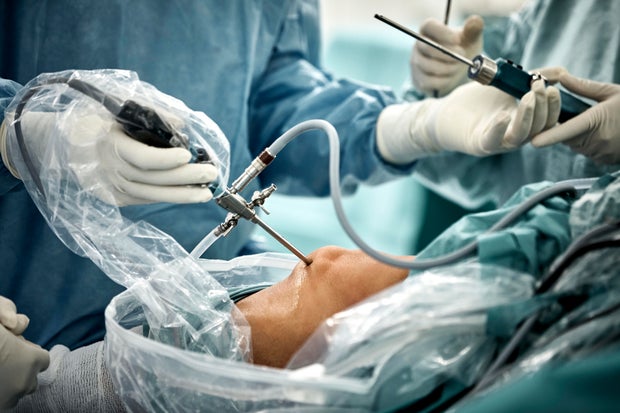
Evidence has been accumulating steadily for over a decade that arthroscopic knee surgery to shave torn, degenerative cartilage does not help more than physical therapy. Arthroscopic rates in Finland have dropped 90%, Järvinen said. They have been falling in the U.S., too, but at a far slower rate.
One study of commercial claims in the U.S., which counted over 2 million meniscus surgeries from 2010 to 2020, found the number decreased by about 4% each year. Most procedures were performed on women and patients in their 50s.
In the traditional Medicare fee-for-service program, the number of procedures has declined steadily in recent years, from about 169,000 in 2014 to 91,000 in 2024, federal data shows. These figures do not include beneficiaries in Medicare Advantage, private insurance plans that cover more than half of Medicare enrollees.
Prior studies of scans have found that such tears are common in people over 50, the result of wear and tear and often not painful.
“Nothing supports the idea that a patient’s pain comes from the meniscus,” Järvinen said.
Robert Brophy, director of the Orthopaedic Clinical Research Center at Washington University in St Louis, said that “evidence is growing for judicious use of this surgery in this population.” But, he noted, “many patients do benefit.”
All the same, he acknowledged that current practice among his peers is “all over the map.” For example, data shows that surgery for meniscus tears in the Medicare population is far more common in the South than in the Northeast.
A massive study committee of orthopedic societies in Europe and the U.S. last summer released a consensus statement noting that “degenerative meniscus lesions can be treated with comparable results with either non-operative (including physical therapy) or surgical approach.” It recommended a trial of physical therapy before surgery but still endorsed the operation.
A concerted campaign by orthopedic specialty societies called the Save the Meniscus Society has been ongoing for years. The group advocates for protecting and maintaining long-term knee health through nonsurgical treatments, surgical repair, and other therapies.
One inherent issue in all medical specialties is that appropriate treatment is often in the eye of the physician beholder, meaning that specialists create the guidelines for when a treatment is in order. And financial considerations may influence that decision, Järvinen said.
In the U.S., physician payments are decided by the Relative Value Scale Update Committee, or RUC, a committee of the American Medical Association composed largely of specialists. Department of Health and Human Services Secretary Robert F. Kennedy Jr. and his advisers have reportedly looked into wresting control of that committee from the association, though it’s not clear how that could be done, since the AMA owns the billing codes used to calculate patients’ charges.
Arthroscopic knee surgery takes 30 to 60 minutes in the operating room, and the patients spend a few hours recovering in a surgery center or in a hospital outpatient department. Medicare allots on average $2,159 to $3,875 for the procedure, depending on where it is performed; patients pay 20% of the fee as coinsurance. There may be additional costs, for example, if more than one doctor is involved in the procedure. Commercial insurers average well more than twice that, said Marcus Dorstel, a senior vice president at the data analytics firm Turquoise Health, adding that the amount providers charge for the procedure varies widely. Those charges do not include the fees of the surgeons and the anesthesiologist.
Treating chronic knee pain has a variegated history.
Fifty years ago, the treatment for cartilage tears, from acute injury or from wear and tear, was to remove the entire piece of cartilage. At that time, doctors did not consider it a shock absorber but a useless, vestigial piece of tissue like the appendix.
Today, the first-line therapy for a painful knee with degenerative tears is physical therapy and, for some people, weight loss. Then there is arthroscopic surgery, depending on the view of the surgeon about its utility.
There is also a menu of injections: Steroids have proved scientifically valuable in the short term. And injections of stem cells and plasma-rich protein are widely offered but are controversial — and not covered by most insurance — because studies have been at best inconclusive about their benefit.
And as orthopedists are backing away from shaving off meniscus tears, they are highlighting a newer procedure — sewing the torn cartilage back into a whole. But that is typically an option for patients under 50 with acute injuries and clean tears, and it is unclear exactly which patients might benefit.
When all else fails, there’s a different surgery that’s also a big moneymaker for hospitals and doctors: knee replacement.
KFF Health News is a national newsroom that produces in-depth journalism about health issues and is one of the core operating programs at KFF — the independent source for health policy research, polling, and journalism.


