

The SS United States and her final destination
Even with her paint peeling and rivers of rust, the queen of the North Atlantic – five city blocks long, 12 stories high – still strikes quite a pose in the setting sun. The SS United States quickly became the fastest ocean liner in history. On her maiden voyage back in 1952, she reached speeds topping more than 40 miles an hour – a record for a transatlantic crossing that’s never been broken.
But she was elegant, too – stately and refined. During her nearly two decades in service, she carried four U.S. presidents, countless celebrities, and tens of thousands of happy voyagers.
But what was once glamorous and spacious, the jet age did away with. Speed won out over starry nights at sea. By 1969, the SS United States was withdrawn from service, and that’s what gets us back to her currently forlorn state. She wound up in Philadelphia, where for almost 30 years she sat with only spiders and sunbeams booking passage.
CBS News 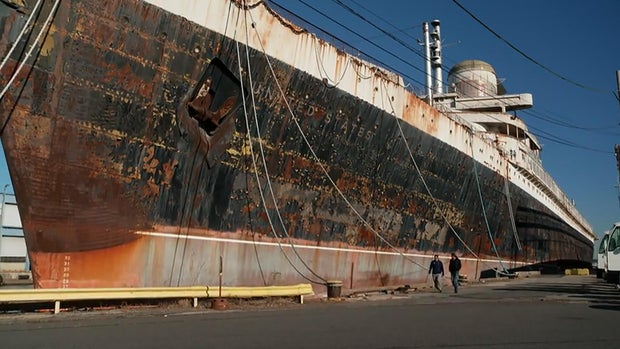
But she was still impossible to ignore.
“She still casts a spell; there’s something about her,” said Susan Gibbs, president of a non-profit called the SS United States Conservancy. “She has always been this unabashedly American symbol that brings so many people together.”
Gibbs knows every inch of this ship. Her grandfather, William Francis Gibbs, designed the SS United States, with the U.S. military helping to foot the bill – a floating investment that could be converted in less than 24 hours into a troop ship to transport an entire division. “It may not seem that way now, but back then she was the space shuttle of her age,” Gibbs said.
Only her bones are left, however – her once-grand staircase is bare; the indoor salt-water swimming pool is now just a ghostly abyss; the dance floor is still here, but nothing else.
CBS News 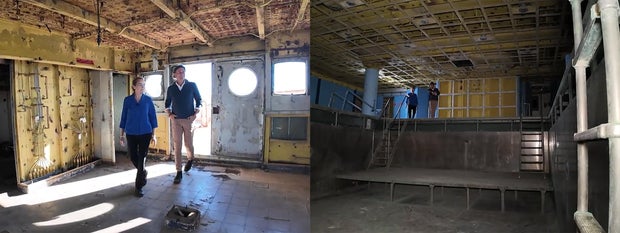
And yet, there was still enough that Gibbs was determined to save. There were all kinds of ideas – museums, restaurants, event spaces – but no takers.
Our one-time flagship seemed headed for the scrap heap. Until that is, one man had a wild idea: return the SS United States back to the Atlantic, not to sail, but to sink – sending her to the bottom of the sea where nature, instead of the wrecking ball, will take its course.
“This will be the largest purposely-sunk artificial reef in the world,” said Alex Fogg.
As the natural resources chief for Okaloosa County, Florida, Fogg has sunk a lot of ships – in fact, dozens of them, smaller ones off the coast of Florida as part of the county’s artificial reef program.
The vessels have created habitats that are a delight for fish, fisherman and frogmen alike. But sinking the SS United States is something entirely different. Just one look at her two massive engine rooms and you realize the enormity of the task ahead.
For Jennifer Adams, director of tourism for Okaloosa County, what better tourist attraction could she bring? When she was approached about buying the SS United States, she said her response was, “‘How much?’ And he told me and I said, ‘Go get her.'”
That price tag? A mere $1 million for the legendary ship, plus another $13 million to ready her for sinking. But then, the idea of sinking her suddenly became a little too real.
“I cried this morning when I walked on board,” Adams said. “I just, I got overwhelmed.”
Her county now owned a historic ship, but one full of 1950s environmental contaminants; that’s problem one. Problem two was the SS United States still had plenty of fans on land, people like Linda Sylva, who made her first voyage as a teenager. “She was made in America, made from American parts, all over America,” Sylva said.
Joe Beaman was just an eight-year-old kid when he set sail. All these years later, he’s never forgotten it. “Oh no, once that ship has your heart, you never lose it,” he said. “I mean, it’s a part of me.”
Even those who never sailed on her, like Jeffrey Smith, felt some kind of pull: “I drove in from Detroit yesterday because I wanted to say goodbye.”
He and the others were on a farewell cruise of sorts, organized by the Conservancy, to give fans one last look before her last port of call.
CBS News 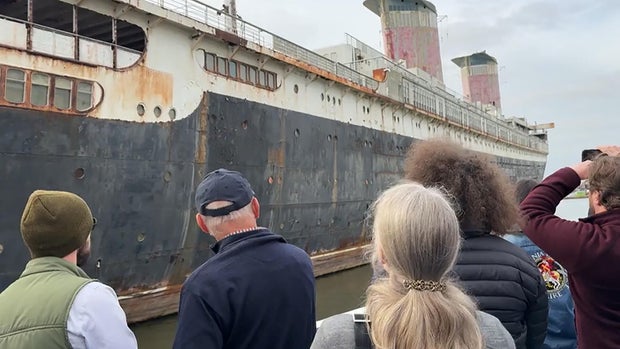
In 2025, crews cast off her lines and began towing the SS United States south, her funnels barely clearing Philadelphia’s Walt Whitman bridge.
Okaloosa County 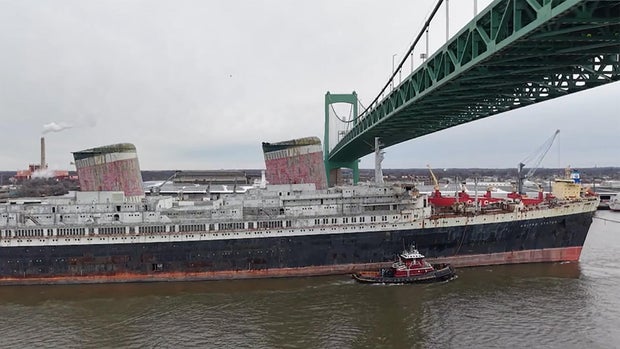
Once at sea, she had all the majesty she always did, cutting the waves like a scalpel. She arrived almost two days ahead of schedule. “She’s still breaking records, even today,” Fogg laughed.
At a shipyard in Mobile, Alabama, she’s undergone extensive remediation, from stem to stern, getting rid of those environmental contaminants. Holes were cut throughout to allow air and water to flow quickly and evenly during her sinking.
Okaloosa County 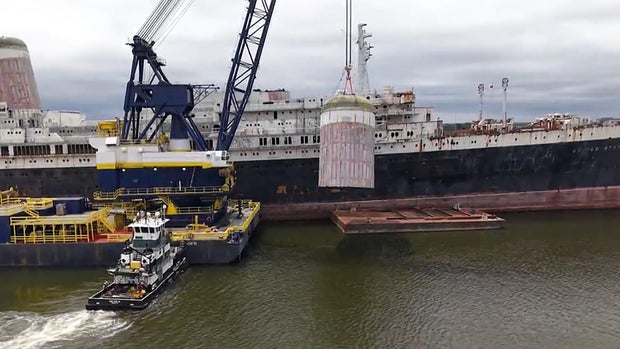
If all goes well, she’ll be scuttled this week about 20 nautical miles off the coast between Pensacola and Destin/Ft. Walton Beach, Florida.
CBS News 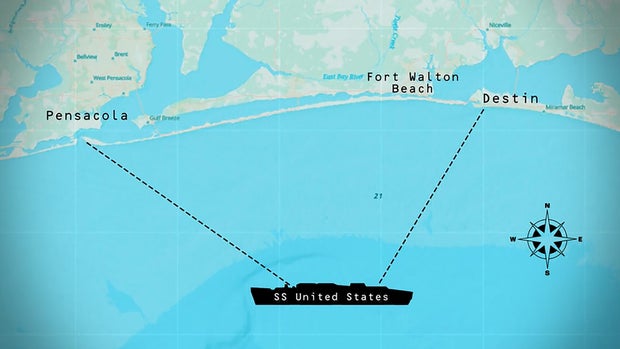
Her two funnels – some of the largest ever built – will become the bookends of a museum planned by the SS United States Conservancy that will eventually house one-of-a-kind artifacts, including the bar from the tourist class smoking lounge.
There will be plenty of salty tears when she’s gone. Sinking seems contrary to everything she was designed to do. That said, the SS United States will remain a part of maritime lore forever.
After so many years alone, soon she’ll become a place of life once again.
“She stood there year after year after year,” said Linda Sylva, “waiting for somebody to say, ‘Come here, you’re welcome here.’ And who is that welcome for? It’s the ocean. What a perfect place for her to rest.”
FROM THE ARCHIVES: Watch a 2013 “Sunday Morning” report on the history of the SS United States (Video)
Story produced by Michelle Kessel. Editor: Carol Ross.
For more info:


