

AI data center backlash fuels votes for change and sharp stock market swings
Concern over AI and misgivings about data center construction helped drive votes for change in the midterm election — and have fueled stock market volatility that experts say is likely to continue.
Investors are worried that the political shift in Congress could slow the buildout of data centers that power AI, potentially throttling one of the economy’s main growth engines.
Voters on Tuesday passed at least 44 of 47 measures proposed across the country to restrict data centers — from outright bans to temporary moratoriums — with a few still pending.
Paul Weaver/SOPA Images/LightRocket via Getty Images 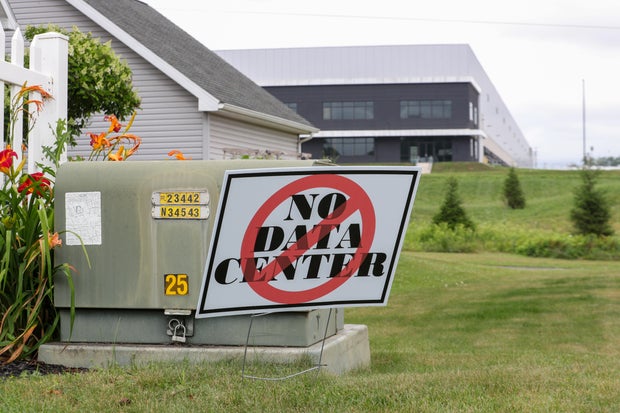
The election also elevated a number of candidates who made stricter regulation of data centers a key part of their campaigns. They include Texas Gov.-elect Gina Hinojosa, who beat Republican incumbent Greg Abbott and who has promised to halt the construction of new data centers until more safeguards are in place.
“What has happened is data centers have moved into mostly rural communities and there are no rules to protect Texas,” Hinojosa told CNN’s Jake Tapper on Thursday. “We need to stop what we are doing with data centers until we have those protections.”
Texas, which did not have a measure on its ballot on Tuesday, has become one of the leaders in the data center market — accounting for 25% to 30% of the data center capacity expected to come online by 2030.
The state has 169 operational data centers, with 118 under construction and more than 500 planned for the future. Big tech companies like Meta, Google and Microsoft have announced major data center projects in the state over the last two years.
Kyle Grillot / Bloomberg via Getty Images 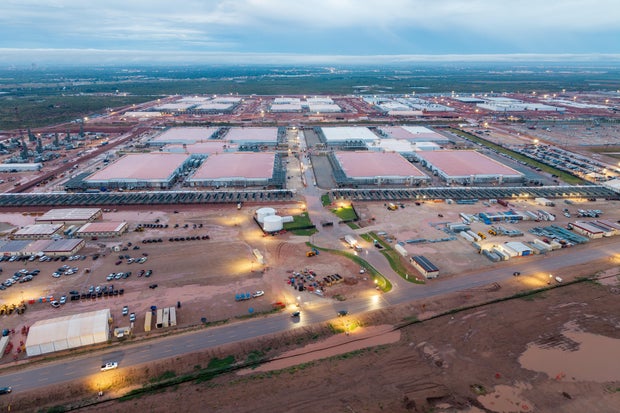
In Georgia, Democratic Gov.-elect Keisha Lance Bottoms told “CBS Mornings” on Wednesday that she would sign an executive order to pause new data center construction once she gets into office in January.
“A lot of data centers are being built in Georgia because of the incentives that have been attached to those data centers,” she said. “So, of course, we’re going to have to take a look at what those agreements entail.”
Stock market swings
Stocks rebounded on Friday morning after plunging on Thursday, a drop that put the tech-heavy Nasdaq into correction and wiped out post-election gains.
Joe Maher, a markets economist with Capital Economics, said in a report Thursday that it remains to be seen if the midterm’s shock to the stock market turns out to be the catalyst that derails the AI equity boom, but said it “strengthens our sense that the boom is in its final innings.”
“That is an obvious headwind for the firms directly involved in that build-out,” Maher wrote.
OpenAI is responding to the backlash. On Thursday, the company laid out plans to build more trust with local communities and to work with them on the development of data centers. The company said it would no longer use controversial nondisclosure agreements with public officials and provide residents access to construction plans.
The AI boom has driven the stock market to record highs, so reversals could dent millions of Americans’ retirement savings and hurt consumer spending, which accounts for roughly two-thirds of U.S. economic activity.
Nigel Green, CEO of investment advisory firm deVere Group, told investors in a research note, “The spending is enormous, borrowing is climbing, and investors want to know when the returns arrive. Asking is healthy. Dumping an entire sector over it is an overreaction.”
He added: “[T]ech had become the most crowded trade on the planet. When everyone owns the same stocks, it takes very little to spark a rush for the exit, and the exit narrows fast.”
President Trump said he is “100% in favor” of AI and vowed to work with states that want to “become RICH by having them.”
“They are GOLD, and only foolish leadership will say “NO” to the riches they bring!” the president posted on Truth Social.
Cracks in AI sector
CBS News business analyst Jill Schlesinger told “CBS Mornings” that the post-election gains in the stock market were about Tuesday’s results as a whole — while the losses that followed appear to reflect that investors have had time to digest the results of the ballot measures around AI.
“What we are hearing is that people are nervous about AI — they want to limit the building of AI,” she said. “That hits not just the AI companies, but the companies that are building those data centers, the companies that are providing the chips for AI and other financing of AI. That brought the entire tech index down, but also it spilled over to other indexes.”
She warned that people should expect more volatility in the stock market.
“What we are now seeing is a repudiation of the AI story,” Schlesinger said. “What were we promised? This is transformative technology, it is, but it’s not profitable yet. All these AI companies are investing in each other. The interconnectedness, the use of borrowed money, that is all coming to a place wherein investors are saying, ‘Wait a second. If they aren’t profitable yet, they owe all this money, what does that mean about the value of the company in and of itself?'”
Schlesinger said the volatility in the AI industry is already impacting the broader stock market, particularly if companies are forced to sell other stocks to cover some of those losses.
“That’s where it could spread,” she said. “It’s not spreading into the economy yet, but if you are a retirement investor, be clear: taking no action is a wonderful action in and of itself long term. Stick with your game plan.”


