

Residents evacuated from Russian-occupied Oleshky during U.S.-brokered ceasefire
Kyiv – Ukrainian and Russian humanitarian delegations began evacuating residents from Russian-occupied Oleshky on Friday, with plans to move the evacuees through Russia and Belarus before arriving back in Ukraine on Saturday.
Oleshky, a city in Ukraine’s southeastern Kherson region occupied by Russia since the first days of the Ukraine-Russia war, has seen one of the most dire humanitarian crises of the conflict. Russian strikes on the surrounding area have prevented food, water, and medicine from reaching the city for months. Last week, first lady Melania Trump brokered a temporary ceasefire in Oleshky from Oct. 28 to Nov. 1 to allow humanitarian aid to enter, and for some residents to evacuate the area. Pope Leo also pressed for a truce.
On Friday morning, Ukrainian and Russian humanitarian delegations reached the city and began administering aid and preparing for evacuations
“Everyone who wishes to leave Oleshky will be given the opportunity to leave safely. At the same time, those who have decided to stay can stay and will receive all the necessary humanitarian support,” Ukraine’s Human Rights Ombudsman Dmytro Lubinets, who led the Ukrainian delegation, said.
The convoy included 25 buses, and some ambulances arrived to deliver food and medicine. Local authorities say about 2,000 people remain in Oleshky.
Office of the Ombudsman of Ukraine via AP) 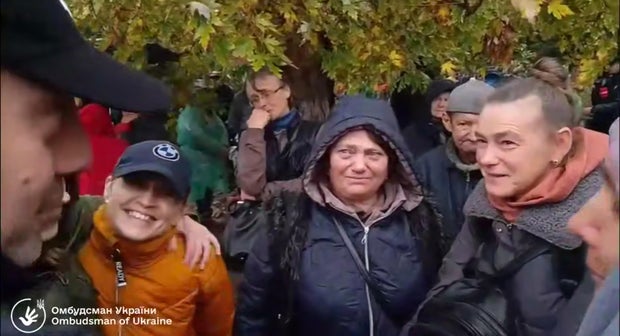
The localized ceasefire comes after President Trump increased pressure on Kyiv to stop striking Russian energy targets ahead of the U.S. midterm elections next week, with some Ukrainian officials doubting Russian motives.
“Because these negotiations were led by the U.S. and Melania Trump, it seems to me that the Russians have agreed to this ceasefire to show that they are a reliable partner for these negotiations and other future peace negotiations with Ukraine,” Vadym Ivchenko, a Ukrainian parliament member on its Defense, Intelligence, and National Security Committee, told CBS News.
But on social media platforms, Ukrainians expressed skepticism about the local ceasefire, and what it could mean for Ukraine’s broader Kherson region, in the midst of its own humanitarian crisis.
“Under the pretext of evacuating people from Oleshky, they are moving their troops forward. This poses a direct threat to the city of Kherson and the Right Bank,” Ukrainian journalist Nastia Nagorna wrote on Facebook. “This risk escalates if such humanitarian missions become a ‘monthly’ occurrence—or take on any other form of ‘regularity.’ It would allow Russian forces, under the guise of delivering humanitarian aid, to amass a significant concentration of troops and resources.”
Fighting has continued elsewhere during the localized ceasefire. On Thursday afternoon, a Russian strike on a passenger train station in Ukraine’s eastern city of Dnipro killed at least 14 people. Overnight into Friday, Russia launched an attack on Kyiv’s energy grid, leaving hundreds of thousands without power, while Kyiv struck a Russian oil refinery for the first time in two weeks.


