

U.S. military destroys alleged drug boat in Pacific Ocean, killing 5 people
The U.S. military said it attacked a boat it accused of smuggling drugs in the eastern Pacific Ocean on Tuesday, killing five people, as the Trump administration continues its campaign against alleged traffickers in Latin America.
The latest attack brings the number of people who have been killed by the U.S. military’s boat strikes to at least 240 in more than 70 strikes. The Trump administration began targeting those it calls “narcoterrorists” in September 2025.
As with most of the military’s statements on strikes in the eastern Pacific Ocean and Caribbean Sea, U.S. Southern Command said it targeted the alleged drug traffickers along known smuggling routes and that “intelligence revealed the vessel’s active involvement in narcotrafficking.”
The military did not provide evidence that the vessel was ferrying drugs. A video posted on X showed a small boat in the water before it was enveloped by an explosion. The vessel does not appear to be moving before it is destroyed.
SOUTHCOM 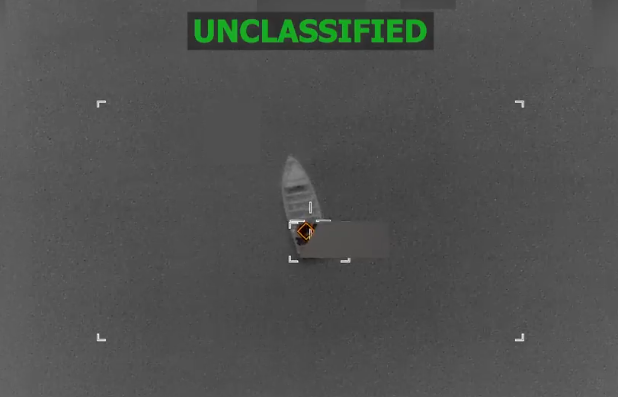
President Trump has said the U.S. is in “armed conflict” with cartels in Latin America and he has sought to justify the attacks as a necessary escalation to stem the flow of drugs into the United States and fatal overdoses claiming American lives. But his administration has offered little evidence to support its claims of killing “narcoterrorists.”
Critics have questioned the overall legality of the boat strikes as well as their effectiveness, in part because the fentanyl behind many fatal overdoses is typically trafficked to the U.S. over land from Mexico, where it is produced with chemicals imported from China and India.
The attacks have drawn intense scrutiny from some Democratic lawmakers and military legal scholars. The Pentagon’s watchdog said in May that it plans to look into whether the U.S. military followed an established targeting framework when carrying out the lethal operations, which include a military commander’s intent, target development and execution. But the evaluation will not probe the legality of the strikes.
Tuesday’s strike is among a few that have followed Secretary of State Marco Rubio’s pledge in September to seek the approval of U.S. allies in the region for carrying out such attacks. Rubio told reporters that while the U.S. has “the capacity to act unilaterally,” it would rather work with its allies because that is “the most effective way to do it.”
Rubio’s statements in Peru last month appeared to signal a shift in strategy. However, Rubio also said the U.S. military would “still blow up ships if need be” and the approach would be “a strike-by-strike or operation-by-operation determination.”
In August, the U.S. military said it carried out a strike on an alleged drug-trafficking boat in the Pacific Ocean, killing two people. The military did not identify the style of boat but it appears to be a long semi-submersible vessel, sometimes called a “narco sub.”
In June, the U.S. military conducted a strike in the Caribbean against a boat accused of smuggling drugs in the region, killing two people and leaving six survivors.
U.S. lawmakers have previously demanded that the Pentagon release “unedited video” of the very first strike that the military conducted after reports emerged that the U.S. chose to conduct a follow-on strike on survivors of its initial attack. Two people who survived that September 2025 strike were attempting to climb back onto the boat before it was hit a second time, a source familiar with the matter told CBS News.
Some lawmakers have questioned whether that follow-on strike constituted a war crime. The Defense Department and several congressional Republicans have insisted the survivors may have still been in the fight, warranting the follow-on strike.
The U.S. used an aircraft painted like a civilian plane in the attack on an alleged drug-smuggling boat from Venezuela that killed 11 people in September 2025, multiple officials confirmed to CBS News.


