

Trump’s focused on voter fraud. Yet he worked to free a former official convicted in an election interference case.
As Colorado reeled from one of the worst wildfires in its history, President Trump seemed to be focused on MAGA warrior Tina Peters.
Peters was a top election official who used her position to chase Mr. Trump’s baseless claim that rigged voting machines cost him the 2020 election. She was sentenced to nearly nine years behind bars, and Mr. Trump was determined to see her freed by Colorado Gov. Jared Polis.
The way Mr. Trump went about demanding Peters’ freedom, critics say, raises questions about how far he’ll go to advance his agenda — and what he’ll do to punish those in his way. The president is now facing a lawsuit filed by Colorado Attorney General Phil Weiser’s office, which helped convict Peters in connection with compromising voting machines.
Why the lawsuit? Weiser said Mr. Trump is “using bullying, using threats to take away our sovereignty. [The] president doesn’t get to tell us what to do. That’s for us to decide.”
Peters’ crimes
The official who oversees Colorado’s elections is Secretary of State Jena Griswold, a Democrat. She alleges Peters helped an unauthorized individual to pose as a county employee, gave him access to secure voting equipment and allowed him to copy proprietary software.
“Tina Peters ordered that her video surveillance cameras be turned off, and then took images of the voting equipment and shared it with a network of election deniers,” Griswold said.
Griswold discovered the breach when copies of the data surfaced at a conference devoted to claims of election fraud. Peters spoke at the event.
Peters was charged with obstruction for refusing to cooperate with an investigation into the voting machine breach. She was indicted a month later on 10 criminal counts, which elevated her standing among election skeptics even higher.
60 Minutes 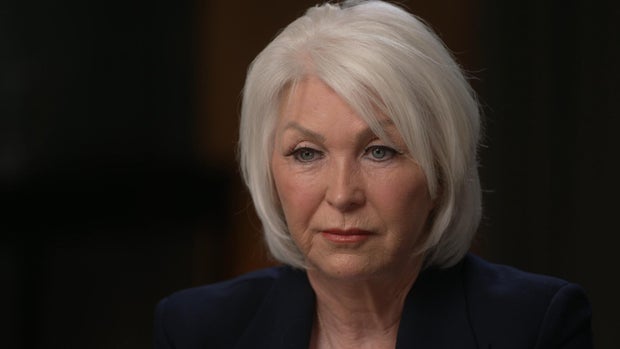
She was all smiles on her way to court in 2024. After a two-week trial, a jury found her guilty of state charges: three misdemeanors and four felonies.
Mesa County District Court Judge Matthew Barrett sentenced Peters to nearly nine years in prison.
“You are no hero. You abused your position, and you’re a charlatan,” Barrett said in court. “I’m convinced you would do it all over again if you could. You’re as defiant as a defendant as this court has ever seen.”
Did the White House punish Colorado for imprisoning Peters?
Weiser, a Democrat, said it’s clear the president decided to punish Colorado because he didn’t like that Peters was convicted and sentenced in the state.
Last year, as a wildfire ravaged Colorado, the president promised “harsh measures” if Peters was not released.
“And then the consequences started to follow,” Weiser said.
Federal wildfire aid was denied — something the White House insists had nothing to do with Peters.
“There is no politicization to the president’s decisions on disaster relief,” spokesperson Lauren Bis said.
But wildfire aid wasn’t the only area where the state was hit. The Trump administration threatened to withhold food aid from the state’s neediest families, canceled $109 million in transportation funding, and moved to dismantle the National Center for Atmospheric Research in Boulder. The Trump administration described the actions as a series of independent agency decisions.
“The threats were not hidden, they were not subtle, they were out in the open, and we’re fighting back,” said Weiser, who’s suing the president, alleging a retaliation campaign.
60 Minutes 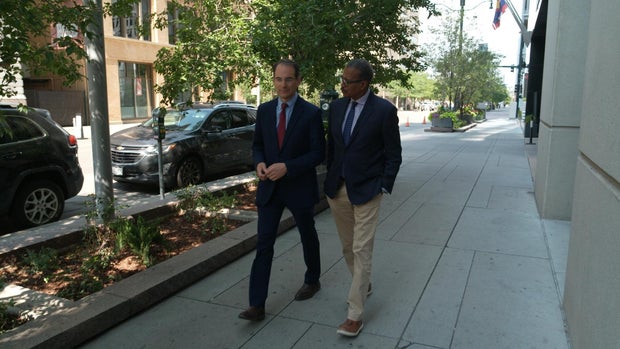
Mr. Trump called Peters a “hostage being held in a Colorado prison by the Democrats for political reasons.” He also called her a patriot.
“I feel like we’re in ‘Alice in Wonderland.’ When someone breaks the law, they’re not a patriot,” Weiser said. “When someone seeks to undermine the integrity of our elections, lying about it, that’s not a patriotic act. That’s undermining the core, the foundation of a democratic republic.”
The president issued a pardon for Peters, but it had no legal effect since she was convicted on state charges, not federal ones. He continued to praise Peters while tearing into Colorado lawmakers, calling Polis a “weak and pathetic man” and referring to him as a “sleazebag governor.”
Peters’ sentence commuted
In May, after Peters had served less than two years, Polis commuted her sentence.
“Look, she should’ve gotten a year, two years, three years,” Polis told 60 Minutes. “When she got close to nine years, I was shocked.”
The Colorado County Clerks Association said in a statement that they were “furious” and “disgusted” by the commutation. Colorado County Clerks Association director Matt Crane, a Republican, said it was “a complete betrayal of the election community” in the state.
“I mean, as simple as it is, [Polis] bent the knee to President Trump,” Crane said.
Polis insists that wasn’t the case.
“This would’ve been much easier to do had the president never mentioned her,” Polis said. “This was a nonviolent, elderly, first-time offender who got a longer sentence than she should’ve.”
Critics question the governor’s timing. The state court system was already in the middle of reconsidering Peters’ sentence when Polis stepped in.
“There is no timeline for commutations and pardons. It’s whenever I make up my mind,” Polis said. “But when it’s made up, it’s made up. There’s no reason to delay.”
60 Minutes 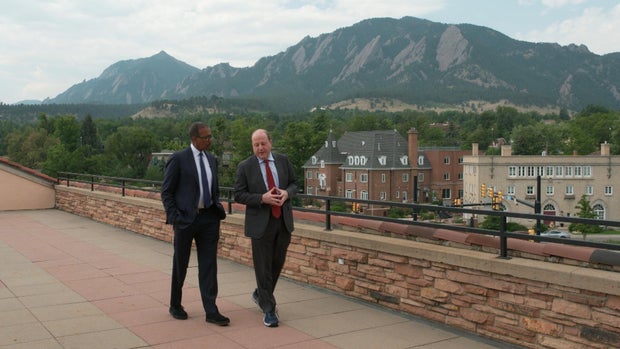
Polis also shared his hopes for Peters.
“I hope that she understands that what she did was wrong,” he said. “She wishes, presumably, that she did it in a legal way rather than an illegal way.”
Tina Peters: Out from behind bars and unapologetic
Peters has returned to the election denial circuit in the months since her release from prison. She attended the Fraud Fighter Summit in Las Vegas, went on conspiracy theorist Alex Jones’ streaming show, and met with Mr. Trump at the White House.
She was unapologetic when 60 Minutes met with her in August, arguing that the ends justify the means.
“The bottom line is, can people trust these machines? Can they really trust these machines? My answer is no,” Peters said.
There were more than 60 lawsuits filed alleging voter fraud in the 2020 election; they were either dismissed or withdrawn. Federal, state and local investigators — Republicans among them — looked into the allegations. None of them found evidence of fraud that would have changed the outcome of the 2020 election.
“You know, I’m not going to debate about what’s happening- across the country in that regard. All I know is that I was the election official in charge of preserving election records. And those election records were wiped from the system,” Peters said.
The records “wiped from the system” were cleared as part of a routine system update across Colorado. All election results were preserved, according to Crane.
“Every record that was required under federal and state law for retention, her staff had already backed up,” Crane said.
Peters, when asked why she turned off the security cameras, told 60 Minutes “it was not against the law.”
“Did I, are you asking me if I broke the law? They said I broke the law,” she said.
According to Peters, it “doesn’t matter” that she was prosecuted by a Republican district attorney in a Republican county. She’s convinced her conviction was unjust.
“Because I do believe these machines can be breached,” she said.
Peters did not give a clear answer when asked if she now plans to run for office.
“I’m a woman of faith. I believe that what God brings you to, he’ll see you through,” she said. “And I’m willing to do whatever needs to be done to save this country.”
Impact in Colorado
Federal funds that had been delayed are flowing to Colorado again: $47 million for water projects was unfrozen, and last month, the Trump administration approved federal wildfire aid for the state.
But Griswold and Crane worry that Peters’ actions harmed voters’ confidence in both election workers and the election system. Her actions, and the president’s support for Peters, fueled distrust in election workers, making them into targets for threats and intimidation, according to Crane.
“As election officials, we don’t have the kind of megaphone that the president of the United States has,” Crane said. “He has much more ability to spread disinformation and lies about our election process than we do to spread the truth about what really happens.”


