

60 Minutes Transcript: Trump’s demand for former Colorado election official Tina Peters to be freed
On the eve of the midterms, President Trump won’t stop talking about voter fraud. Yet he has gone to extraordinary lengths for an election official convicted of helping breach the very voting system she swore to protect.
Tina Peters – once Mesa County, Colorado’s top election official – used her office to pursue the president’s claim, never backed by evidence, that rigged voting machines cost him the 2020 election.
A Colorado jury convicted her. A judge sentenced her to nine years. Mr. Trump wanted her freed. How he went about it, critics say, reveals how far he’ll go to advance his agenda and punish those who stand in his way.
In Colorado, the cost of that punishment came into focus with a fire in August of 2025.
It was one of the worst wildfires in Colorado history, scorching nearly 138,000 acres. It left almost all of Kathleen Kelly’s 2,000 acre ranch in ashes.
Bill Whitaker: Did you see it moving toward you?
Kathleen Kelly: Yeah.
Bill Whitaker: What’s that like? What goes through your head?
Kathleen Kelly: It’s like watching a monster crawl across the earth.
Kathleen Kelly: This tells you about the fire right here.
Bill Whitaker: So it came right up to your house?
Kathleen Kelly: Yeah.
60 Minutes 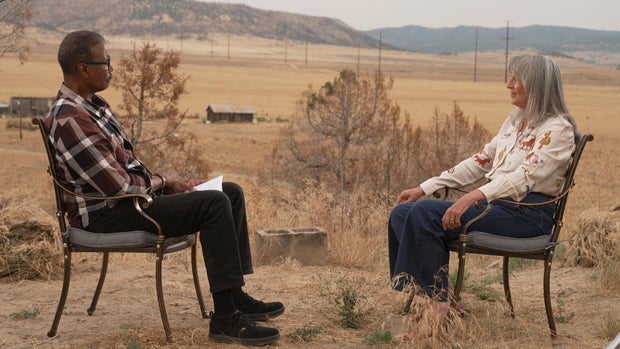
Kelly, a retired schoolteacher, says the Lee fire tore through the ranch her father built in 1949, leaving behind an apocalyptic wasteland.
Bill Whitaker: You said it was like hell opening up.
Kathleen Kelly: Yes. There are people whose whole livelihoods depend upon the buildings, the structures, the things that they built over years, who lost everything.
Gov. Jared Polis: A lot of the damage was oil and gas infrastructure, some homes, buildings. It absolutely met the requirements for a federal disaster declaration.
Even so, the Trump administration denied Democratic Gov. Jared Polis’ plea for federal aid.
Gov. Jared Polis: These are disasters that are larger than any particular state can pay for and handle at one time. We had not been turned down for one. I think it’s been decades since– that’s occurred.
Bill Whitaker: What was different this time?
Gov. Jared Polis: Well, you know obviously I’m not the one to ask, right? The person to ask is the White House and– and– and the president.
60 Minutes 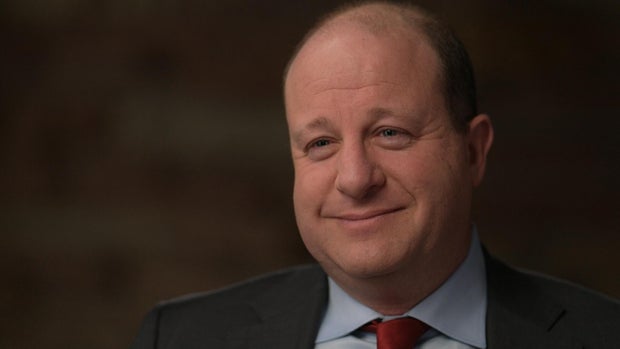
What was different this time, critics say, was President Trump’s fixation on Tina Peters, who has long championed his false claims about rigged voting machines.
Colorado’s Democratic Attorney General Phil Weiser’s office helped convict and imprison Tina Peters in connection with tampering with voting machines.
Phil Weiser: President Trump has said he doesn’t like that Tina Peters was sentenced and serving this nine year sentence. So he said, “I’m gonna punish Colorado.”
Last year, as the Lee fire raged across northwest Colorado, the president warned on social media: “If she is not released, I’m going to take harsh measures.”
Phil Weiser: That was the statement the president made. And then the consequences started to follow. “If Colorado doesn’t wanna lose these benefits, it might consider treating the Tina Peters case differently.”
The White House insists denying wildfire aid had nothing to do with Peters. Spokesperson Lauren Bis said “There is no politicization to the president’s decisions on disaster relief.”
But the fire aid was only the beginning. The Trump administration threatened to withhold food aid from the state’s neediest families, canceled $109 million in transportation funding, and moved to dismantle the National Center for Atmospheric Research in Boulder – actions the administration described as a series of independent agency decisions.
Phil Weiser: The threats were not hidden, they were not subtle, they were out in the open, and we’re fighting back.
Bill Whitaker: So you are suing the president. On what basis?
Phil Weiser: The president using bullying, using threats to take away our sovereignty… President doesn’t get to tell us what to do. That’s for us to decide.
Bill Whitaker: So when the president posts, “Free Tina Peters,” what does that say to you?
Phil Weiser: I don’t get it. The president appears to think that there’s some injustice here.
Jena Griswold: She was elected by her county to uphold the elections. Instead– she attacked the elections from within.
Colorado’s Democratic Secretary of State Jena Griswold, who oversees state elections, said Peters helped an election conspiracy theorist pose as a county employee, gave him access to secure voting equipment and allowed him to copy its proprietary software.
Jena Griswold: Tina Peters ordered that her video surveillance cameras be turned off and then took images of the voting equipment and shared it with a network of election deniers.
Griswold discovered the breach when copies of the data surfaced at a conference devoted to claims of election fraud where Peters spoke.
Bill Whitaker: What was harmed by her actions?
Jena Griswold: Voting equipment, confidence in Colorado elections and American elections, and election workers.
Tina Peters: You let go of me. Let go of me!
Peters was charged with obstruction for refusing to cooperate with an investigation into the voting machine breach.
Officer: You’re under arrest
Tina Peters: For what?
Officer: Obstruction
She was indicted a month later on 10 criminal counts, which elevated her standing among election skeptics even higher.
She was all smiles on her way to court in 2024. After a two week trial, a jury found her guilty of state charges: three misdemeanors, four felonies.
Judge Matthew Barrett: You are no hero. You abused your position, and you’re a charlatan.
Mesa County District Court Judge Matthew Barrett sentenced Peters to nearly nine years in prison.
Judge Matthew Barrett: I’m convinced you would do it all over again if you could. You’re as defiant as a defendant as this court has ever seen.
Matt Crane, who leads the Colorado County Clerks Association, says Peters’ actions and the president’s support for her have fueled distrust of election workers, making them targets of threats and intimidation.
Matt Crane: As election officials, we don’t have the kind of megaphone that the president of the United States has. He has– he has much more ability to spread disinformation and lies about our election process– than we do to spread the truth about what really happens.
Bill Whitaker: And you are a Republican.
Matt Crane: I am a Republican. Yes, sir.
Bill Whitaker: So this is not a partisan issue for you?
Matt Crane: This is not a partisan issue
But in May of 2025, President Trump made it one. He called Peters a “hostage being held in a Colorado prison by the Democrats for political reasons.” He also called her a patriot.
Phil Weiser: I feel like we’re in “Alice in Wonderland.” When someone breaks the law, they’re not a patriot. When someone seeks to undermine the integrity of our elections, lying about it, that’s not a patriotic act. That’s undermining the core, the foundation of a democratic republic.
60 Minutes 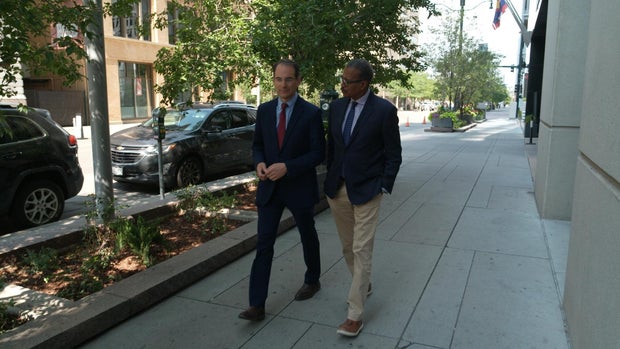
President Trump issued a pardon for Peters – but it had no legal effect since she was convicted on state not federal charges.
President Trump continued to build up peters while tearing into Colorado Gov. Jared Polis.
President Trump: The governor of Colorado is a weak and pathetic man
Bill Whitaker: President Trump is known for using colorful language. He called you “the sleaze bag governor of Colorado.”
Gov. Jared Polis: I mean, whatever he wants to call me is fine.
Bill Whitaker: He called you a sleaze bag. He called Tina Peters a hostage.
Gov. Jared Polis: That’s not a fair characterization of Tina Peters.
Gov. Polis said he fully agreed with the jury’s conviction of Tina Peters but felt her sentence was too long.
Gov. Jared Polis: Look, she should’ve gotten a year, two years, three years. When she got close to nine years, I was shocked. Many people were shocked.
In May, after Peters had served less than two years, Mr. Polis commuted her sentence and set her free – the county clerks said they were furious and disgusted.
Matt Crane: It was a complete betrayal of the election community here
Bill Whitaker: So why do you think Gov. Polis commuted her sentence?
Matt Crane: I mean, as simple as it is, he bent the knee to President Trump.
Bill Whitaker: You’ve heard all the blowback from your critics. They say that you caved to the president. Did you?
Gov. Jared Polis: No. This would’ve been much easier to do had the president never mentioned her. This was a nonviolent, elderly, first-time offender who got a longer sentence than she should’ve. Straightforward case.
But the governor’s critics question his timing. The courts were in the middle of reconsidering her sentence when Mr. Polis stepped in.
Bill Whitaker: The legal process was still ongoing. So why did you intervene?
Gov. Jared Polis: I had what I needed to, to act.
Bill Whitaker: But why– why jump in before the– the court had rendered its final decision?
Gov. Jared Polis: Well I mean, look, there is no timeline for commutations and pardons. It’s whenever I make up my mind. But when it’s made up, it’s made up. There’s no reason to delay.
Bill Whitaker: You said you believe in, as you put it– in the value of mercy and redemption. But you said that that certainly also means taking responsibility. Has Tina Peters shown that she’s taken responsibility for what she did?
Gov. Jared Polis: I hope that she understands that what she did was wrong. She wishes, presumably, that she did it in a legal way rather than an illegal way.
But, since her release, Peters is back on the election denial circuit. She attended a Fraud Fighter Summit in Las Vegas, went on Alex Jones’ podcast, and met with President Trump at the White House.
When we met with Tina Peters in August, she was unapologetic and argued the ends justify the means.
Tina Peters: The bottom line is, can people trust these machines? Can they really trust these machines? My answer is no.
Bill Whitaker: Show me the evidence that the paper ballot results differed from the computerized results.
60 Minutes 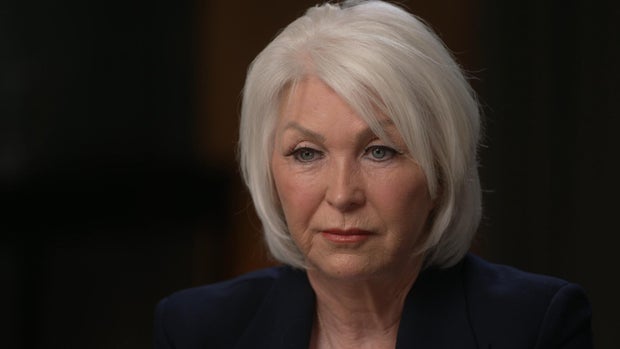
Tina Peters: Well, my place is not to show– you know, pick out different things and what– what could have happened. Mine was, I was authorized to– protect the election records according to 52USC.70201, which is a federal mandate to preserve election records.
Bill Whitaker: More than 60 lawsuits were filed alleging voter fraud in the 2020 election, and they were either dismissed or withdrawn. There were multiple investigations by federal, state, and local investigators, many of them Republican. None of them found evidence of fraud that would have changed the outcome of the election. Is it possible that you’re wrong?
Tina Peters: You know, I’m not gonna debate about what’s happening in — across the country in that regard. All I know is that I was the election official in charge of preserving election records. And those election records were wiped from the system.
We checked. The “wiping” she speaks of turned out to be part of a routine system update of voting machines across the state. County Clerks Association director Matt Crane, a Republican, says all election results were preserved.
Bill Whitaker: It’s kind of like the updates all of us do for our phones?
Matt Crane: That’s correct, that’s correct. Only a lot more secure and a lot more intentional.
Bill Whitaker: Tina Peters has said that she was just protecting election data.
Matt Crane: Yes
Bill Whitaker: What’s wrong with what she said?
Matt Crane: The fact that every record that was required under federal and state law for retention, her staff had already backed up.
Bill Whitaker: You took an oath.
Tina Peters: I did.
Bill Whitaker: To do this job.
Tina Peters: Yes.
Bill Whitaker: Why turn off the security cameras?
Tina Peters: It was not against the law.
Bill Whitaker: You gave an outsider fake credentials.
Tina Peters: Okay. Oh, we’re gettin’ into it now –
Bill Whitaker: Did you break the law?
Tina Peters: Did I– are you asking me if I broke the law? They said I broke the law.
Bill Whitaker: You were prosecuted by a Republican district attorney.
Tina Peters: Doesn’t matter.
Bill Whitaker: In a Republican county–
Tina Peters: Doesn’t matter
Bill Whitaker: What makes you think your conviction was unjust?
Tina Peters: Because I do believe these machines can be breached.
Bill Whitaker: Do you plan to run for office?
Tina Peters: I plan to do– I’m– I’m a very– I’m– I’m a woman of faith. I believe that what God brings you to he’ll see you through. And I’m willing t– to do whatever needs to be done to save this country.
Tina Peters got out of prison and delayed federal funds are flowing to Colorado again: $47 million of water projects was unfrozen. Also, last month, the Trump administration approved federal wildfire aid for the state.
Produced by Sarah Koch. Associate producer, Amanda Winograd-Schnur. Edited by April Wilson.


