

60 Minutes Transcript: Election officials describe impacts of federal actions on voting
The midterms are just two weeks away and President Trump is using his power to intimidate the people who run our elections, putting the voting system under remarkable stress.
The latest move came on Friday when the Justice Department threatened to prosecute California election officials if they knowingly count mail-in ballots from 20,000 people the Trump administration says are “likely noncitizens.”
It’s the latest in a sequence of actions that has bred an erosion of faith in the integrity of our elections.
Our story focuses on how state and local election officials are being pressured – in a way that is stoking that distrust. We start with what happened in Georgia this past January.
What you’re seeing is extraordinary: armed federal agents seizing ballots from a local election facility.
Dana Barrett: In my wildest dreams, I never imagined that we would be raided by the FBI.
Fulton County Commissioner Democrat Dana Barrett got a text message that sent her racing to this warehouse near Atlanta.
Lesley Stahl: Were the FBI agents inside by the time you got here?
Dana Barrett: They were. They had vests. They had guns. They had all of the equipment on their belts as if they were raiding a drug house.
There were dozens of agents who gained entry to the warehouse with a criminal search warrant that allowed them to seize ballots and other election materials from the 2020 election.
Lesley Stahl: Is there any way that you could have said no?
Dana Barrett: No. They had a valid warrant signed by a judge. We did not have a choice.
60 Minutes 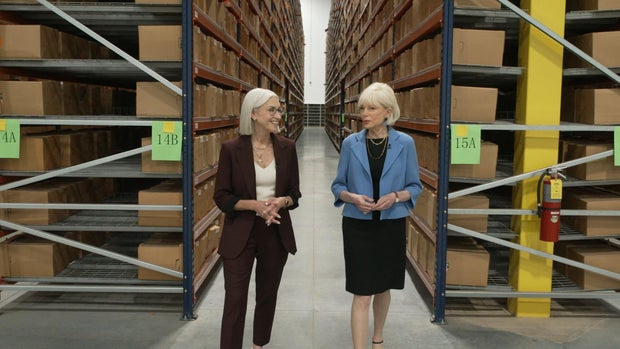
The agents worked all day packing up more than 600 boxes of election records. After night fell and Director of National Intelligence Tulsi Gabbard arrived, the boxes were loaded onto trucks and disappeared.
Lesley Stahl: Where are the ballots now?
Dana Barrett: We have no idea.
Lesley Stahl: You don’t know where they took them?
Dana Barrett: Nope.
Lesley Stahl: Do you know what they were going for?
Dana Barrett: Look, it was in my opinion political theater aimed at undermining the 2026 and 2028 elections.
Lesley Stahl:You think it was an intimidation for the next election?
Dana Barrett: I think it was all part of this concerted effort that’s happening nationwide to undermine faith in elections.
We obtained this internal FBI email temporarily reassigning “260” analysts to work on a “priority investigation” into the Georgia materials. That was three months ago… and nothing has come of it yet. There have been dozens of probes into the 2020 election in Georgia and none have moved the needle.
Dana Barrett: You take a fraudulent claim. You investigate it at the state level. Then the federal level refers to what the state did. And people just see all of these investigations and FBI raids and subpoenas and they say, “Something must be wrong there. Why should I believe the results?”
The Trump administration has cast more doubt about the reliability of our elections by investigating voting machines and actual ballots, which the Justice Department has attempted in several states.
The lieutenant governor of Utah, Deidre Henderson, told us it’s a kind of interference she’s never seen before.
Deidre Henderson: In the past two elections that I oversaw as lieutenant governor the threats were all external. Non-state actors, cyber security threats and other things. But now we also have threats coming from within our own government.
Lesley Stahl: Your federal government.
Deidre Henderson: That’s right.
60 Minutes 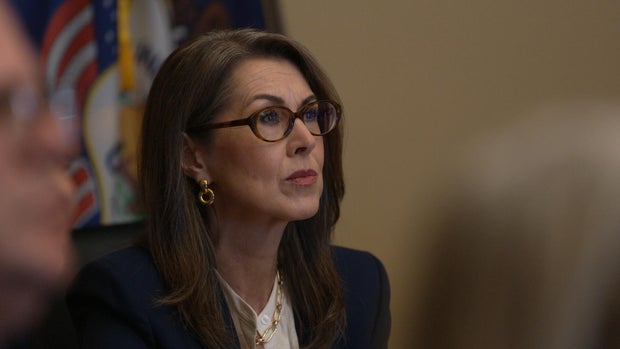
Henderson is responsible for Utah’s elections: everything from voter registration to counting the ballots on Election Day. Keep in mind Henderson is a Republican in a deeply red state. President Trump won the last election here by more than 20 points.
Last year the Justice Department zoned in on Henderson, and her counterparts in states across the country, demanding their “statewide voter registration list,” which includes voters’ confidential personal information. Henderson had never seen anything like it. She said no.
Deidre Henderson: They wanted things that we typically are required by law to keep private: social security numbers, full dates of birth, driver’s license numbers.
Lesley Stahl: Why? Why did they want that?
Deidre Henderson: We just weren’t given very good answers and we were concerned about what they would do with that data.
Officials in 29 other states – Democrat and Republican – felt the same and so they also refused to comply. The Justice Department has sued all of them, saying it needs access to voter rolls to help ensure that immigrants who are not entitled to vote don’t.
Lesley Stahl: They think that you’re allowing ineligible voters to go and vote, and they feel it’s a federal obligation to stop that. Why is that wrong?
Deidre Henderson: Across the board, nobody I know wants anyone who isn’t eligible to be able to vote.
State audits have shown that noncitizen voting is extremely rare, though it does happen. In Utah Henderson found only 52 who were questionable out of more than 2 million voters.
Lesley Stahl: We did a calculation that that’s two thousandths of one percent.
Deidre Henderson: Yeah.
Lesley Stahl: So, has it ever been an issue in Utah?
Deidre Henderson: No.
Henderson has been notified that if she knowingly allows any noncitizens to vote in Utah she could be prosecuted, and even sent to prison.
In July, Secretary of Homeland Security Markwayne Mullin spelled it out:
Markwayne Mullin: Those individuals can also be held accountable by fines, by penalties and even depending on how far it goes, prison time.
Election officials in California have been put on notice, too. The Justice Department has threatened to prosecute them for essentially the same crime: And President Trump put out a social media post Friday about California: “They will all go to jail for a long period of time!!!”
Lesley Stahl: You could go to prison.
Deidre Henderson: We’re not going to prison. No. It’s silly.
Lesley Stahl: You’re absolutely sure?
Deidre Henderson: Well.
She’s right to say “well.” The Justice Department told Henderson last month she is officially “under investigation.”
Lesley Stahl: You are toe-to-toe with the president of the United States. It’s a big thing that you’re doing.
Deidre Henderson: I’m just doing my job.
Lesley Stahl: Standing up to the federal government that’s threatening you with jail time, it’s bold at– the very least.
Deidre Henderson: I have to– I have to tell myself it doesn’t matter what the consequences are, if– as long as I feel like I’m doing what’s right. I think this is an important thing for me to do, holding these guard rails, holding the line. Someone has to.
Other Republicans, like Gov. Mark Gordon of Wyoming, also pushed back when election monitors from the Justice Department in August demanded access to his voting machines.
Gov. Gordon: I feel very strongly about the federal government coming in and taking our guns. I don’t like that. And I don’t like the federal government coming in and taking our votes, either.
Things escalated when President Trump defied history and the constitution with a shocking statement on a podcast.
President Trump: The Republicans should say, ‘We wanna take over. We should take over the voting.’ The voting in at least many, 15 places. The Republicans ought to nationalize the voting.
In America elections are local. They’re run by towns and counties and states. It’s all in Article 1 of the Constitution. Congress makes laws regulating elections…
But the president doesn’t have a role in running them. That hasn’t stopped Mr. Trump from signing two executive orders trying to create new federal voting rules.
Harmeet Dhillon: Noncitizens cannot vote in federal elections, so the question is simply how many of them there are.
Harmeet Dhillon, the head of the Civil Rights Division of the Justice Department, has spearheaded the government’s voter roll initiative. She spoke to us from California.
60 Minutes 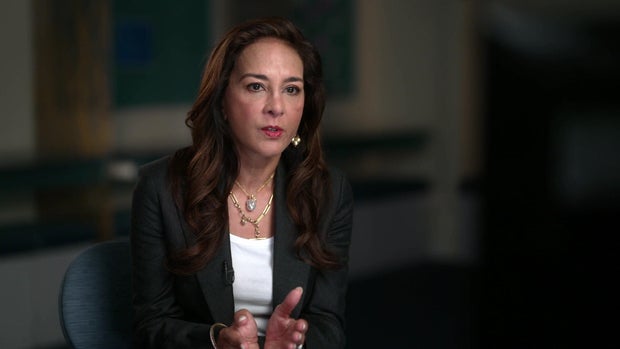
Lesley Stahl: There are people who feel that the point is to sow distrust about the whole election system. There are very few people who are noncitizens who end up voting. Very, very few. And so therefore what’s the purpose?
Harmeet Dhillon:The point is actually the opposite of what you were saying. It’s not to sow distrust. The distrust is there. And so all of these kinds of crimes are being prosecuted now for the first time really in volume. And look, even the Biden administration prosecuted 13 people for noncitizen voting —
Lesley Stahl: 13 people. I mean, the numbers are tiny.
Harmeet Dhillon: So Lesley, we’ve been in office for less than two years. We’ve had investigations ongoing for over a year,and it takes time. There are literally thousands of them out there that we are looking at.
The pile up of investigations, charges of voting hanky-panky, have caused voters to lose faith in our election system.
Democrats have cast doubt on our elections too.
But it’s a question of degree.
In the 21 months of President Trump’s second term, he has said, in so many words, the vote can’t be trusted — more than 150 times.
The president is only turning up the volume. listen to him at the Republican Midterm Convention last month asking his supporters to make a promise.
President Trump: That I will go out with my family, my friends. I’ll do it any way. I don’t care if I’m registered or not. I’m going to try and cheat like hell like they do.
Lesley Stahl: One argument is that when the president of the United States keeps saying that the system is rigged, people lose confidence. You don’t think it’s rigged, do you?
Harmeet Dhillon: In terms of rigged, I definitely think that there were irregularities in prior elections. But I think people are more sensitive to it now.
Lesley Stahl: Is the administration planning to send ICE agents out to the polling places?
Harmeet Dhillon: There is no plan to do that.
Dhillon dismissed that concern and called the notion that President Trump might challenge the results of the midterms “paranoia.”
Lesley Stahl: So would you consider a noncitizen voting an irregularity that would lead to a challenge of the vote?
Harmeet Dhillon: I think that would lead to the person’s vote being challenged, but not the entire election.
Lesley Stahl: What I’m hearing you say is that you think it’s very unlikely that a vote, a state vote, will be challenged. But people worry about that. Can you rule it out?
Harmeet Dhillon: Well, I don’t know what is going to happen, but I can tell you that absent some shocking contingency that is unexpected, there should be no interruption in the usual course of counting and certifying the results in the states.
With just 16 days til the election, polls are showing that only half of Americans expect the midterms to be “free and fair.”
Lesley Stahl: We have swing states where elections are almost always really razor-thin close. What about Wisconsin? What about Georgia? Can they have honest, fair elections?
Deidre Henderson: They can have honest and fair elections. Whether or not the losing candidates accept those results is the question. And we are seeing a trend of candidates who lose races now refusing to concede saying it was rigged, saying it wasn’t fair, even when it isn’t close. Candidates who lose can do so much good by graciously conceding. That will instill confidence in the public.
Produced by Andrew Bast. Associate producers, Emily Cameron, Madeleine Carlisle and Georgia Rosenberg. Broadcast associate, Aria Een. Edited by Joe Schanzer.


