

Only 2 countries held known public executions last year. The U.S. is preparing for its first in 90 years.
When Nidal Hasan is put to death by firing squad during a public livestream, he will become the first person to be publicly executed in the United States in nearly a century.
The Defense Department announced Thursday the execution of Hasan, the ex-Army major who was convicted in the 2009 killings of 13 people at Fort Hood, will be livestreamed on Dec. 3. Hasan is paralyzed from the waist down and confined to a wheelchair after being shot in the back by police who responded to the mass shooting.
“He’s gonna get a firing squad of soldiers, as it should be,” Defense Secretary Pete Hegseth told Jack Posobiec on Real America’s Voice. “We’ll make sure that people are able to watch it, that it’s public — because people need to understand that there’s serious consequences for these types of things.”
The decision has generated widespread, bipartisan criticism.
Bell County Sheriff’s Office via Getty Images 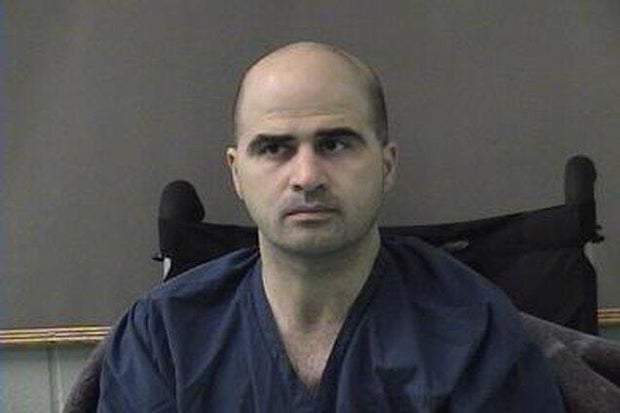
The list of countries that still carry out public executions, whether on video or in a public place, is very short and almost entirely countries accused of human rights violations.
Afghanistan and Iran are the only two known countries to execute anyone publicly in 2022, 2023, 2024 and 2025, according to Amnesty International. Yemen publicly executed multiple people in 2021, according to the group.
“Hasan should face the death penalty, but making his execution public and streaming it? Beyond disgusting,” Republican Sen. Thom Tillis wrote on X. “Public executions are what oppressive dictatorships like Iran and Afghanistan do. It should not be happening in America.”
History of public executions in U.S.
Two public executions in the mid-1930s are considered to be the last public uses of the death penalty in the United States.
The last large-scale example of a public execution in the United States was Rainey Bethea in 1936. The crowd on hand to watch the hanging was estimated at 20,000 people, according to a local newspaper at the time.
Bethea was accused of raping and murdering a 70-year-old woman in her home in Owensboro, Kentucky, in June 1936. He accidentally left his recognizable prison ring at the scene, and confessed to the crime several times, though he did recant during a failed appeal.
He was never convicted of murder, only rape, which still carried the death penalty. Bethea, who was 26 years old, was hanged on Aug. 14, 1936.
Hulton Archive/Getty Images 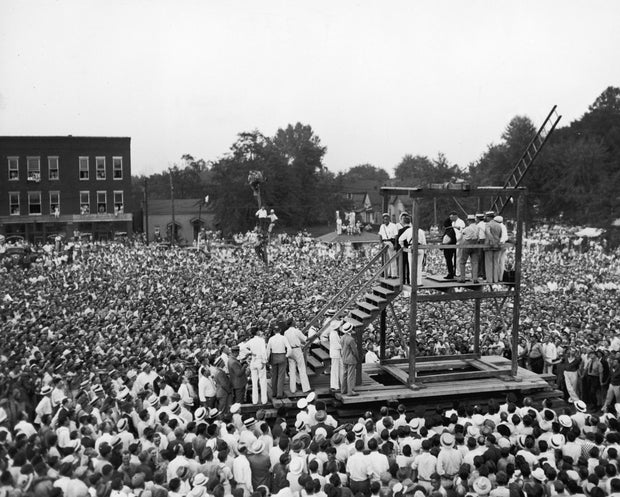
A year later, Roscoe “Red” Jackson was executed in Galena, Missouri, also by hanging. He was convicted of killing a traveling salesman and stealing his car after being picked up by the victim as a hitchhiker.
The crowd for Jackson’s execution was much smaller, since it was not held in the public streets of the city like Bethea’s hanging.
“Just how many were inside is not known, though it is thought the space would accommodate at least 400 people,” wrote the authors of an article on the execution from the local Stone County News-Oracle.
“Executions shouldn’t be public spectacle,” Human Rights Watch interim U.S. Program Director Michael Bochenek told CBS News in a statement. “The death penalty is a relic of an inhumane past and should be abolished once and for all.”
Public executions in Iran
Iran, which the United States has accused of gross human rights violations, is one of the most prolific users of public executions in the world currently. The U.S. and Iran are also locked in a war, and President Trump has routinely cited Iran’s executions of protesters as a reason the regime deserved to be deposed.
At least 24 people were publicly executed in Iran from 2022 to 2025, according to Amnesty International.
Fifty-nine people were executed this year in Iran between March 18 and Aug. 31, including dozens who took part in anti-government protests earlier this year, according to Human Rights Watch. Five of those executions have been public, the organization said.
While not capital punishment, thousands of protesters were also killed by government troops opening fire on those demonstrations.
In late February, eight days before launching strikes against Iran, Mr. Trump said he had threatened military action against Iran if they publicly executed hundreds of people.
“They were going to hang 837 people, and I gave them the word, if you hang one person, even one person, that you’re going to be hit right then and there,” Mr. Trump said. “I wasn’t waiting two weeks and negotiating. And they gave up the hanging. They didn’t hang 837, supposedly they didn’t hang anybody.”
Public executions in Afghanistan
Afghanistan has publicly executed at least 12 people since 2022, according to Amnesty International, though its reports note there were possibly more.
Public executions in Afghanistan have spiked since the Taliban swept back into power in August 2021. Executions have even been carried out in front of thousands of onlookers in sports stadiums, including one in November 2024 that earned worldwide condemnation.
“I condemn today’s horrific public execution,” Richard Bennett, who monitors human rights violations in Afghanistan for the United Nations, said in a statement at the time. “These atrocious punishments are clear violations of human rights and must be immediately halted.”
Another person, reportedly convicted of murder, was publicly executed in a sports stadium in October 2025, according to the U.N.
The Taliban regularly carried out public executions during their first period of rule in the 1990s, until the U.S. invasion in 2001 forced them out of power.
Public executions elsewhere in the world
North Korea is also believed to carry out public executions, though reporting is difficult from the extremely isolated country.
In February, Amnesty International put out a report that included interviews with North Korean defectors who said they had been forced to watch public executions as a way of warning them against committing similar supposed crimes — sometimes for as little as watching foreign television programs.
“Authorities told everyone to go, and tens of thousands of people from Sinuiju city gathered to watch,” one female defector interviewed by the human rights group said. “They execute people to brainwash and educate us.”
Saudi Arabia, which was widely criticized for its public executions for decades, has apparently ended its use entirely in recent years. The infamous Deera Square, where many beheadings took place in the capital, Riyadh, has not hosted an execution since 2019, according to Reuters.
The death penalty is still used frequently in Saudi Arabia, even if not public. There were a record 347 people executed in 2025, according to the European Saudi Organisation for Human Rights. The year prior 345 people were executed. By comparison, 47 people were executed in the United States last year.
The Iran-backed Houthi militant group, which controls large areas of western Yemen, also sometimes carries out public executions. Though not recognized as the controlling government, they do hold enormous power in the country. Nine people were executed at once in public in 2021 for the killing of a Houthi general, according to the Geneva International Centre for Justice.
“International human rights bodies have long found public executions as incompatible with the prohibition on cruel, inhuman or degrading treatment or punishment,” Justin Mazzola, deputy director of research at Amnesty International USA, said in a statement to CBS News. “The claim that the death penalty serves as a greater deterrent is simply unfounded: there is no evidence that it has a unique deterrent effect. The death penalty does not make us safer.”
“Livestreaming the taking of a life by firing squad would only compound the cruelty of the death penalty and perpetuate the cycle of violence that the authorities purportedly seek to end,” he added.


