

DACA renewal applications face record delays, costing some their jobs
Beneficiaries of the Deferred Action for Childhood Arrivals program have been waiting longer than they ever have before for the government to decide on renewing their deportation protections, federal data shows, leading some to lose work authorization in the interim.
While the number of people whose DACA protections have expired due to delays is not clear from publicly available data, the number of active DACA holders declined by 14%, to 436,350, between September 2025 and June 30. Meanwhile, the backlog of pending renewal applications has more than quadrupled over that timeframe, to over 125,000. DACA recipients file for renewal every two years.
“You feel like you don’t have agency, like nothing that you do is good enough because it’s outside of your control,” said Juan Carlos Cerda, whose DACA renewal application took six months to process, causing him to take unpaid leave from his role as the Texas director for the American Business Immigration Coalition. “I had to pull back on spending and had to cut bills, things that were not necessary in order to make ends meet.”
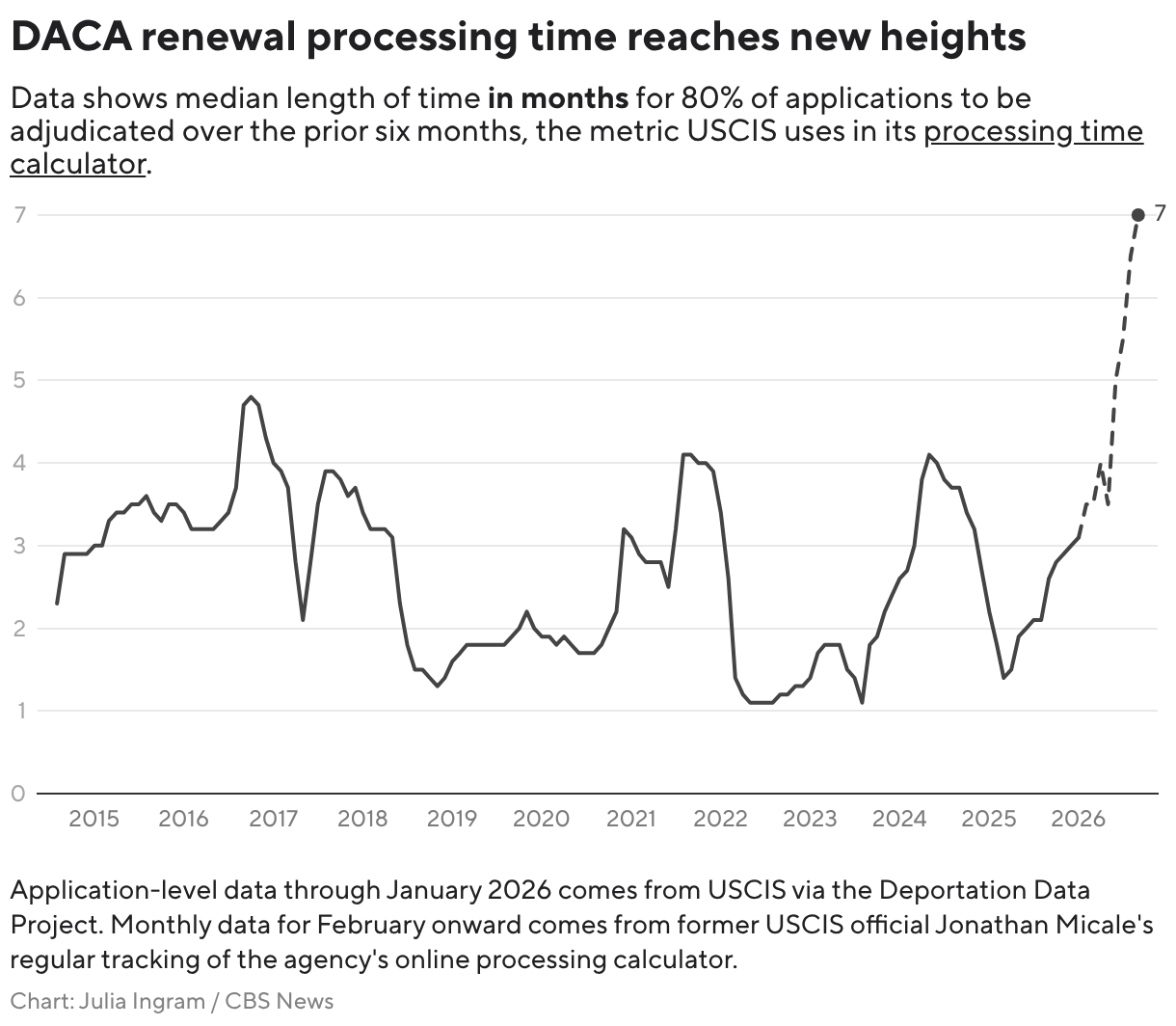
U.S. Citizenship and Immigration Services says over the last six months, it adjudicated 80% of applications within seven months of submission. The agency’s guidance, however, says that beneficiaries should apply for renewal only four to five months before their status expires.
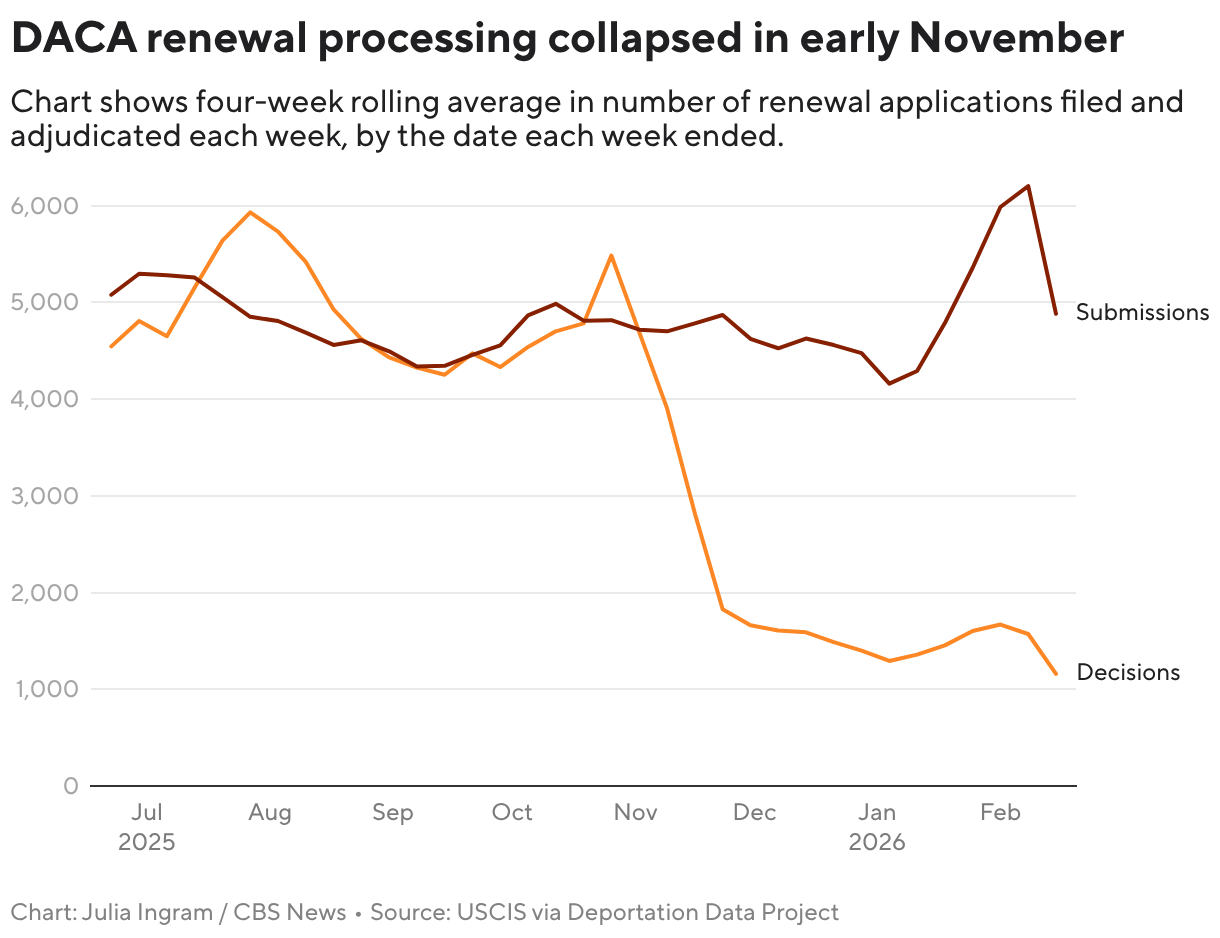
Processing of DACA renewal applications rapidly declined last November, when USCIS went from adjudicating an average of 4,500 to 6,000 applications per week to fewer than 1,900 each week, according to CBS News’ analysis of data obtained from the agency by the Deportation Data Project.
While that data only runs through mid-February, USCIS’ quarterly reports indicate processing may have sped up since then, with USCIS adjudicating four times as many renewal applications from April to June as they did from January to March. But as submissions kept coming in, the backlog’s size remained largely unchanged.
USCIS spokesperson Zach Kahler wrote in a statement to CBS News that the agency has “placed a renewed emphasis on robust alien screening and vetting, eliminating policies the former administration implemented that prioritized aliens’ convenience ahead of Americans’ safety and security.”
The agency directed adjudicators in April to resubmit some pending applications for immigration benefits for enhanced FBI background checks, and months before that, to probe applicants’ social media accounts for “anti-American” sentiment. Some adjudicators are shifting into fraud and security roles, a former USCIS official told CBS News.
The slowdown in processing is not unique to DACA. USCIS reports show that the backlog of work authorization applications for noncitizens across the board has increased by 60% from December 2024 to August 2026. The backlog of pending applications for adjustment of status for asylum seekers has increased by about 80%, and for naturalization by 50%.
But while immigration has long divided the American public, polls show protections for childhood arrivals have received support across the political spectrum. The program, implemented in 2012 by the Obama administration, requires beneficiaries to have entered the U.S. before they turned 16, have lived in the country continuously since June 15, 2007, and have no serious criminal convictions. For years, members of Congress have tried and failed to enact legislation granting legal status to childhood arrivals.
Nearly half of all DACA recipients live in California or Texas, and 82% were born in Mexico, according to the latest USCIS data. Due to a 2021 injunction from a Texas federal court, USCIS currently only processes DACA renewals, rather than new applications.
Months in limbo
Javier Diego Jacinto told CBS News he came to the U.S. with his parents from Oaxaca, Mexico, when he was 6 years old. He was approved for DACA protections in 2013, and since then, had always gotten his biennial renewal approved within two to three weeks, he said.
But this time, he waited from December 2025 until last month before he was approved. At the end of March, his DACA status and work authorization expired, and he had to leave his job as a school associate principal.
Diego, now 27, and his wife have two young daughters. Losing his income meant “really re-prioritizing our life,” Diego said, shifting how they shop for groceries and being careful about gas mileage. Without health insurance from his job, Diego said he also had to try to “not end up anywhere near an emergency room.”
Losing his DACA status also limited his ability to attend certain lectures or events for his Ph.D. program in Los Angeles, he said.
“I really feel like my dignity and my worth was just taken away,” Diego said. “As soon as this card expired, it felt like all the doors shut.”
By the time his DACA renewal was finally approved, his old role had been filled. Shortly after, Diego was hired as a full-time staff member at a local church he previously volunteered at.
Javier Diego Jacinto 
Business owners who employ DACA recipients are also affected when those employees lose work authorization. In construction, losing a worker mid-project can lead to delays and cause the contractor to incur late penalties, said John Martinez, president and CEO of the Regional Hispanic Contractors Association.
“DACA are some of the most well-educated people that we have in construction,” he said. “And even if that person comes back to you in a month, two months, 90 days, that project has already been impacted, and many of our members work on government-related projects.”
Kahler emphasized in his statement that DACA does not confer legal status in the U.S. The Obama-era program was intended to provide temporary protections from deportation and work authorization for those who are approved.
But those who aren’t getting approved before their existing protections expire become more vulnerable to arrest and removal.
Cerda said he did not drive around as much during the six-month wait for his renewal for fear of being arrested, and did not leave the state to avoid running into state troopers.
“It just doesn’t make sense for us to not be productive, not be working every day, not contributing, and then to be sent back to a country that we’re really not a part of,” he said.
Unprecedented delays
The enhanced vetting USCIS said it is applying to DACA renewal applicants has not been accompanied by a significant increase in the number of denials — for the most part, applications are simply taking longer to get approved, the data shows.
Since the drop-off in processing last November through June, the denial rate was 1.1%, according to data from USCIS. From 2013, when the agency began processing renewals, to November, the denial rate was 0.67%.
Jonathan Micale, who held leadership roles in USCIS’ Texas Service Center from 2012 until he left for private practice in October 2025, told CBS News the slowdown could be due to the agency moving adjudicators from DACA to other cases or efforts. In his tracking of job postings at the agency, he said he’s noticed many new roles for fraud efforts or officers who conduct applicant interviews, with more than half being filled by existing employees. Few openings are being posted for officers who decide on applications, he said.
“That is indicative that a lot of employees are being moved from what I would consider to be adjudication roles to fraud and national security roles,” he said. “If they’re moving to go do security and vetting, they’re not adjudicating the cases.”
Temporarily shifting adjudicators’ priorities is typical, Micale said, but the data shows that a sustained slowdown of this magnitude is unusual for the agency.
DACA renewal wait times have ebbed and flowed in previous years — reaching nearly five months in 2016 and more than four months in 2021 and 2024 — but typically sped up after a few months. This time, wait times have exceeded four months since June, and have yet to peak.
“I think what’s different this time is just there seems to be a decision to permanently pull these officer resources in a way that hasn’t occurred before and to just sort of accept that the backlogs are what they are,” Micale said.


