

Americans are paying 62% more for water than a decade ago. Here’s where costs have risen the most.
Americans aren’t only paying more for food amid stubbornly high inflation — the cost of washing it down has also surged.
Water costs have shot up across the U.S., with a new study by the nonprofit advocacy group Food and Water Watch showing that households are paying 62% more for water at home than a decade ago. Those expenses are rising as utilities invest more in aging infrastructure and in adapting their systems to cope with the effects of climate change, Food and Water Watch said in its study.
Federal support for the nation’s water infrastructure has declined. The 2025 Infrastructure Report Card, an evaluation by the American Society of Civil Engineers, said that since fiscal year 2022, Congress has appropriated at least $1 billion below the authorized funding levels for a federal fund that supports state water infrastructure projects.
A 2023 survey by the Environmental Protection Agency projects that drinking water systems across the U.S. will need $625 billion in investment over the next two years to implement upgrades and meet health requirements.
Food and Water Watch based its findings on data from 500 of the largest community water systems around the country that serve a combined 155 million people. More specifically, Food and Water Watch looked at how much utilities charged for 60,000 gallons of water, the estimated amount households use for drinking, showering, laundry and similar purposes in a year. The study did not include bills for wastewater or stormwater, which are managed by separate utilities.
How are water costs changing across the country?
The average water bill across the 500 systems Food and Water Watch studied was $531 last year. However, the amount someone pays can vary widely depending on where they live. The government-run water system in Hempstead, New York, charged people an average of $133 a year last year, the lowest rate of the systems examined in the study.
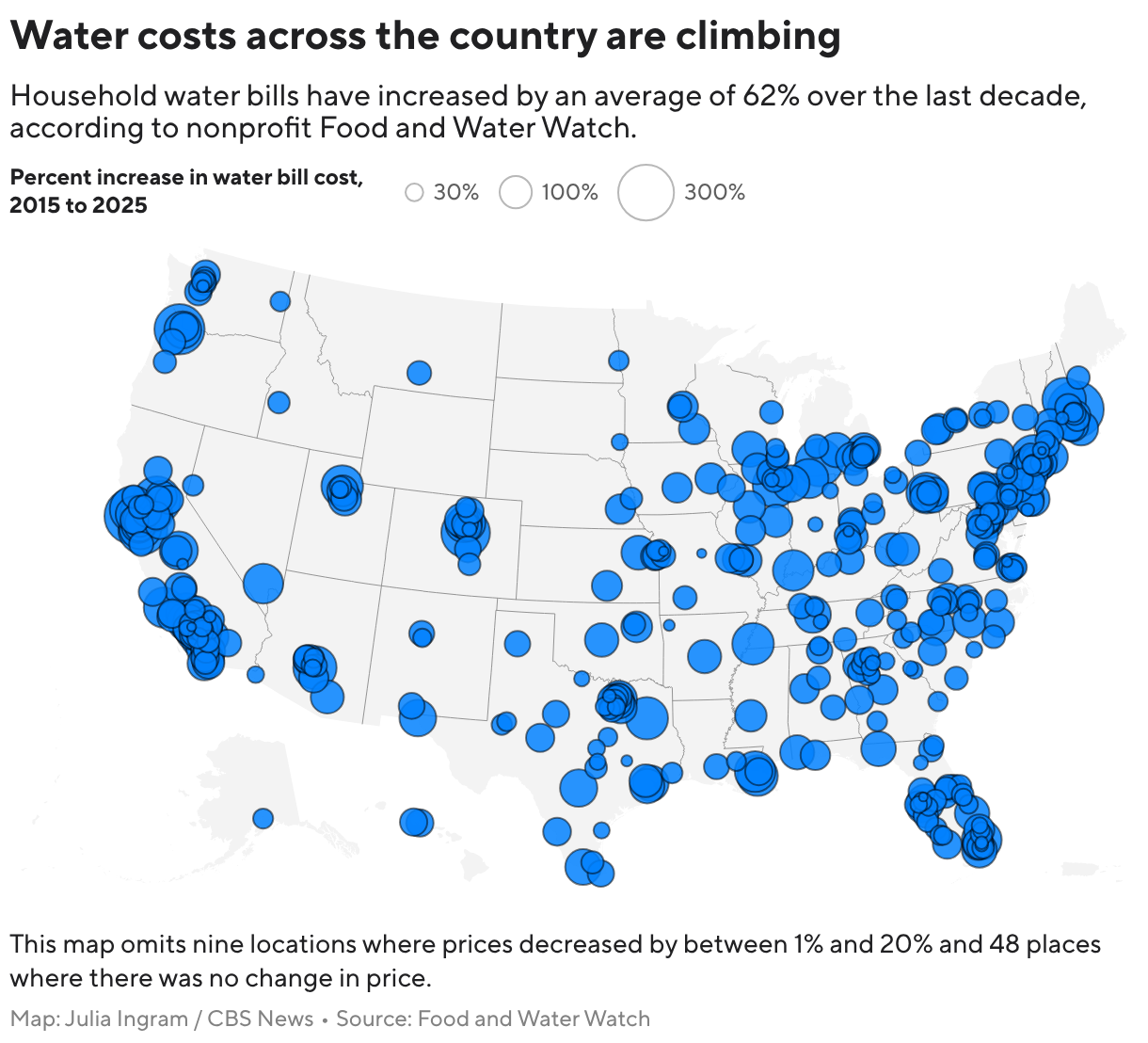
On the other end of the spectrum is San Jose, California, where the private-sector company San Jose Water charged residents an average of $1,416 in 2025, up 163% from a decade ago, the group found.
The state with the lowest overall bills was Idaho, where three of its largest water systems charged an average of $286 in 2025. West Virginia, which has some of the highest poverty rates in the country, had the highest bills. The two largest systems there, owned by American Water, charged an average of $1,383 a year, according to Food and Water Watch.
Costs were higher in counties where water systems are run by for-profit corporations, the group said. Those private companies charged an average of $823 for water in 2025, $329 more than what the public systems charged.


