

Sports betting apps prod and entice fans as gambling exacts a growing financial toll
When Meta agreed last month to pay states $17.1 billion in penalties and make major changes to address claims that its platforms are addictive, attorney Jennifer Hoekstra already had her eyes set on the next frontier in the consumer backlash to Big Tech — sports betting.
Hoekstra, a Florida attorney whose firm was involved in an earlier win in court against Meta, recently filed a series of 15 lawsuits against the two biggest sports gambling apps in the country, FanDuel and DraftKings. The cases follow a similar legal theory: that gambling apps were designed to addict.
“I represent individuals who have essentially lost their houses and their spouses and their kids over this,” Hoekstra told CBS News. “It’s the same type of workflow, the same type of notifications. It’s almost as if it’s the same type of addiction.”
At a time when online sports gambling has exploded in popularity — with the amount wagered reaching $167 billion last year, according to the American Gaming Association — there are mounting concerns about the financial toll of all that betting.
One UCLA study published earlier this year found that in states that legalized sports gambling online, bankruptcies and credit card delinquencies increased about 25%. A survey by the National Council on Problem Gambling found 8% of American adults, almost 20 million people, reported experiencing at least one indicator of problematic gambling behavior “many times” in the past year.
Gaming companies are vigorously fighting the cases, and dispute the notion that they are fueling addictive behavior. FanDuel, the largest online platform, told CBS News that “any claim that we don’t aggressively take actions to monitor and curb problem behavior is completely false.”
FanDuel, which has about 18 million customers, said it invested $158 million on responsible gaming and removed 5,700 people from the platform due to their gambling behavior last year.
A CBS News investigation has found that gaming companies are pushing hard to keep bettors engaged — even in cases where gambling losses are mounting.
“It’s less about cutting them off than slowing them down,” a former FanDuel employee told CBS News, speaking under the condition that he not be identified because he did not want to jeopardize his current job. “It’s never forever.”
Getty Images 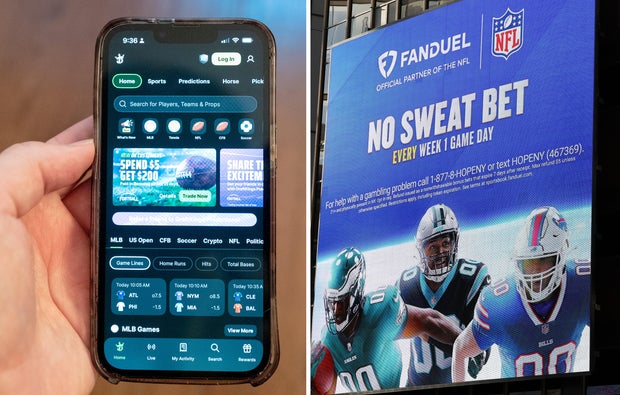
The gambling company insider said some of the people he worked with at the company looked away when customers might be betting too much.
“I had conversations with people where they would say, ‘Well, we know what we should do, but … we don’t want to slow them down from placing a bet.”
VIP perks help keep customers betting
Sports gaming apps deploy both low- and high-tech tactics to keep customers betting.
Much as Las Vegas casinos plied high rollers with gourmet meals and lavish entertainment, sports gaming apps are now rewarding VIP bettors with luxury suite access, autographed jerseys and unique fan experiences.
Esteban Ruiz-Haynes had never been to a pro hockey game until he started wagering on sports apps. Before long, Ruiz-Haynes was sitting 20 feet from scoring champ Alex Ovechkin at Washington Capitals games and walking the sidelines at the Baltimore Ravens’ stadium.
A pest control salesman from the middle of Virginia, Ruiz-Haynes said he soon became a VIP member with his own FanDuel manager texting with him about upcoming sporting events to attend. The VIP manager even messages him on his birthday.
“Just another friend,” Ruiz-Haynes said.
Ruiz-Haynes has also amassed a stash of FanDuel gifts — like a signed helmet from a Washington Commanders player and signed jersey from an NFL Pro-Bowler.
How much does Ruiz-Haynes bet with FanDuel? He said anywhere from $80,000 to $120,000 a year, which is about the same as what he earns at work making door-to-door sales.
He says there are times he will wager his weekly paycheck on a single game, if it looks promising. If he wins, he says it’s like he got paid double. And if he loses, “I’m eating ramen noodles for the rest of the week.”
Louis Ruggiero, a podcaster and a recovering gambling addict who lives in New York City, says that after he lost $100,000 on FanDuel in three months, they offered to make him a VIP bettor. Two other gambling companies offered him VIP status as well.
“From that moment forward, I wasn’t just a customer, I was a target,” Ruggiero recently wrote.
CBS News 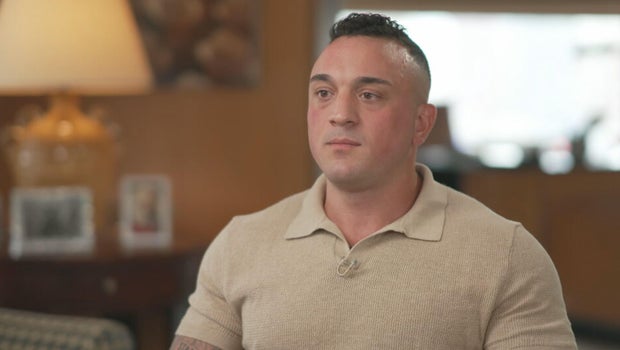
“The incentives got bigger. The outreach got more personal. The losses got deeper,” he said. “Let’s call it what it is: This is not ‘VIP treatment.’ This is predatory retention disguised as hospitality.”
Data collection and “the dopamine hit”
At the same time companies lavish attention on prolific gamblers, they are also running sophisticated data operations.
The former FanDuel employee told CBS News the company was easily able to keep tabs on its customers’ betting behavior — detecting if a gambler was betting within a normal range, or if their activity is fading.
“Their data collection is among the best I’ve seen at any company I’ve worked at,” the insider said.
And if bettors took a break, he said, they would often target them with push notifications to try to get them gambling again.
Hoekstra, the lawyer, alleges in the lawsuits she filed that those notifications and bonus alerts eventually create a persistent ambient presence in a gambler’s life, inviting reengagement at moments of boredom, stress, financial anxiety or emotional vulnerability.
“It’s the dopamine hit,” she said.
The lawsuits Hoekstra has filed lean on a similar legal theory to the landmark social media case that was adjudicated in California in March, on which her firm assisted. In that case, the plaintiff’s attorneys alleged social media companies led a young user down a dark path of mental health agitation. A California jury found Meta and YouTube negligent and ordered the companies to pay damages of $4.2 million and $1.8 million respectively.
Hoekstra said the case was novel because the legal team for the plaintiff — who was 17 when the case was filed in 2023 — argued, for the first time, that it was the design of the social media platforms that was addictive and caused the harm. Now Hoekstra is taking that argument and tailoring it to online betting platforms. She says, just like social media, the gambling apps are designed to addict their users.
A DraftKings spokesperson said the company cannot comment on pending litigation, but added that “the company takes responsible engagement concerns very seriously. All company employees are trained on responsible engagement annually.”
“I couldn’t stop”
For recovering gambling addicts like Ruggiero, claims that the technology is designed to addict them ring true. He said he was wagering tens of thousands of dollars on games at one point in his life. Periodically Ruggiero said he would try to stop gambling — like when his son was born.
“I’m in the hospital holding my newborn son, who is three hours old, and I got $10,000 on the Knicks-Pelicans game,” he recalled. “I couldn’t stop.”
“That thing is engineered to keep you going,” he said.
Joe Maloney, the president of the Sports Betting Alliance, a betting advocacy group funded by gambling companies, said cases like Ruggiero’s are outliers and that the vast majority of bettors gamble online responsibly.
“It is for entertainment. It is not for wealth creation,” Maloney said.
Maloney said online gambling companies are aware that some bettors spend too much time or money on their apps, so the companies offer bettors a suite of responsible gaming tools to help them cope. They allow participants to set deposit limits, wager limits and loss limits, among other tools.
“Even those that might have a sense of perhaps chasing losses, or maybe perhaps spending too much time, or even too much of their own money — they have the ability to use these limits,” he said.
If you or a loved one needs help, the National Problem Gambling Helpline offers resources. Call or text 1-800-MY-RESET or get more information on their website. Gamblers Anonymous also has a national hotline at 1-855-222-5542.
Read the full statement from FanDuel:
“The legalization of online sports betting in the United States transformed an industry that operated in the shadows, handled by offshore operators, illegal bookies and organized crime, into a highly regulated, transparent, professional and accountable marketplace with clear guardrails. It has also helped law enforcement identify and prosecute criminal activity and brought awareness to gambling addiction by destigmatizing the problem and connecting thousands of individuals with treatment and care.
“We take seriously our responsibility to operate in a manner that is worthy of the trust our customers and regulators place in us and any claim that we don’t aggressively take actions to monitor and curb problem behavior is completely false. Every FanDuel customer has access to financial information about their play on our site and a robust suite of tools that support informed and controlled play, including deposit limits, timeouts and the ability to easily self-exclude with a few clicks. Accounts are also continuously reviewed by trained specialists who may engage directly with customers or apply protective measures when appropriate, including placing limits or exclusion. Last year we, along with our parent company, invested $158 million on responsible gaming – efforts that along with our monitoring and regulatory policies resulted in one million customers being blocked from creating accounts because their identity could not be verified, 58,000 manual account reviews by our responsible gaming operations team and the proactive removal of 5,700 people from our platform for responsible gaming reasons.”
Read the full statement from DraftKings:
“While DraftKings is not commenting on pending litigation, the company takes responsible engagement concerns very seriously. All company employees are trained on responsible engagement annually. DraftKings is the only U.S. operator with a Chief Responsible Gaming Officer, who reports directly to the CEO and leads a team of more than 50 full-time employees focused on responsible engagement. DraftKings built unique proprietary tools—My Budget Builder and My Stat Sheet—and offers customers a suite of tools to set custom cool-offs and place limits on deposits, wagers, time and losses to help customers play within their means. Responsible engagement is embedded across our business and essential to DraftKings’ long-term sustainability.”
John Kelly contributed reporting. Story produced by Jake Rosenwasser. Editor: Ed Givnish.


